
Originally published in INCITE Magazine Volume 44, Issue 3
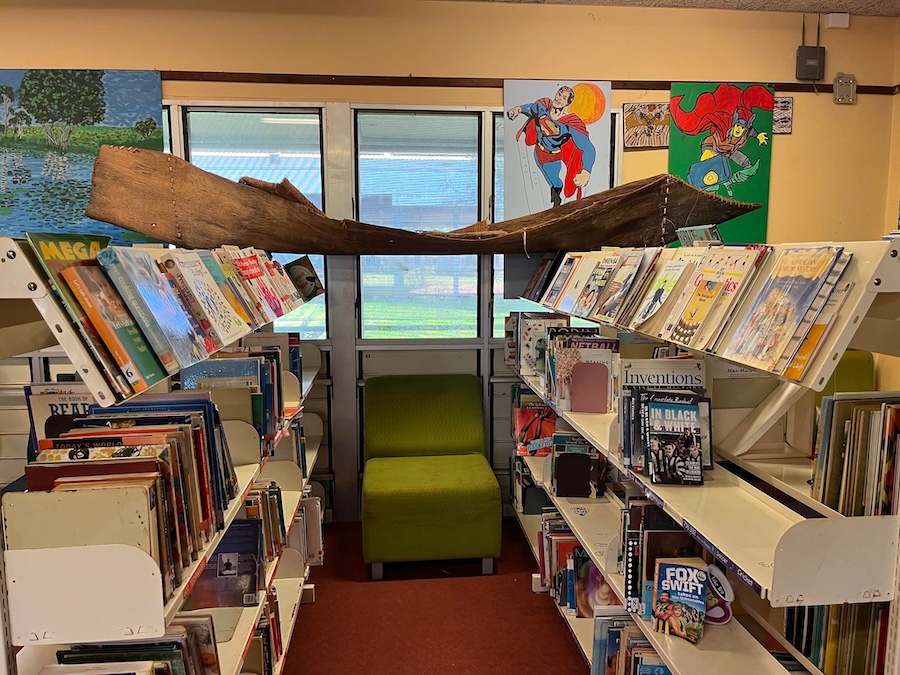
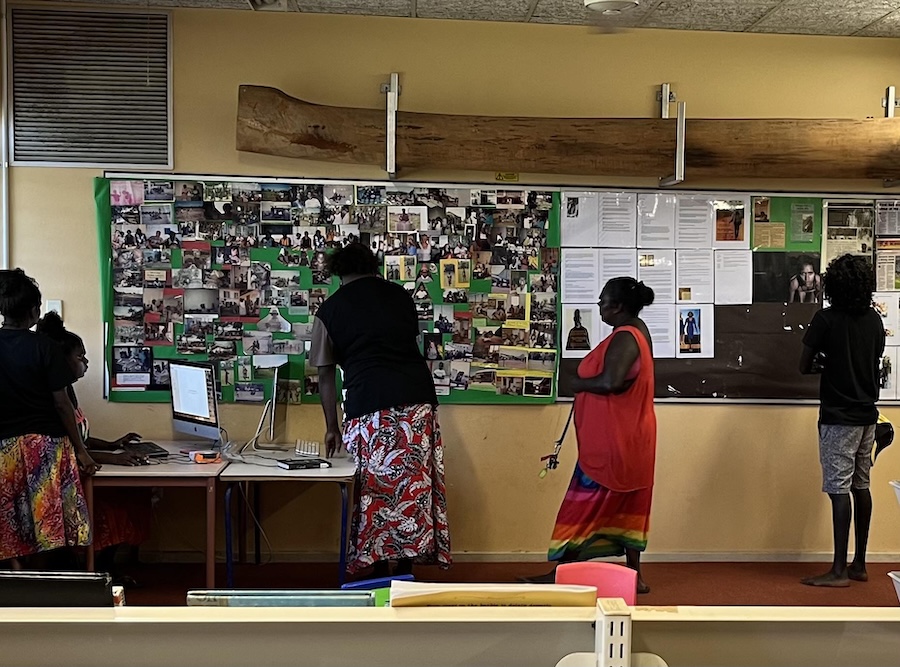
Behind an unassuming door in the grounds of the Milingimbi School in the Northern Territory you will find the Milingimbi Community Library. On the shelves - a collection that includes a variety of books in local language, English, LOTE alongside books that explore the historical events of Milingimbi from the perspective of its local inhabitants. And on the walls you will find a display of newspaper articles, photographs and printed information that tell the stories of some of Milingimbi’s community leaders, local heroes and high achievers throughout the years. Some of these faces include Janet Baird who made her AFLW debut with the SUNS in 2021, ARIA award-winning artist Baker Boy, Wirrinyga Band, and artist Sam Djimbarrdjimbarrwuy Garawirrtja who worked on the Milingimbi Easter Panel in 1965 which is now in the National Gallery of Australia.
The creator of this display is Jacinta Burukumalawuy Dhamarrandji, one of the local Indigenous Community Library Officers in the East Arnhem region. These officers host groups and activities at the library, and develop outreach programs. They also support community members to use the library and to access and use the internet and digital media.
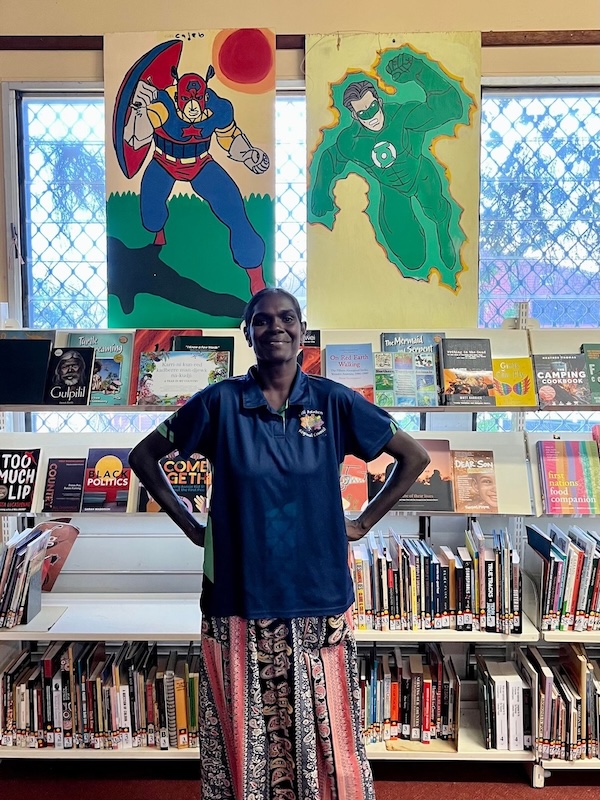
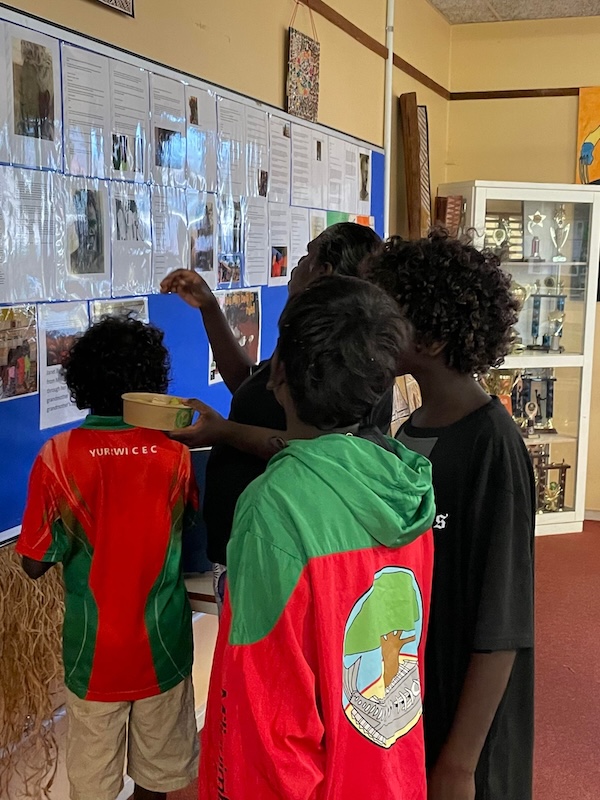
But it is this wall of stories that makes Milingimbi Community Library distinctive.
“I love watching what I’ve created right in front of me” Jacinta tells us. “Every day that’s what catches my eye. And sometimes I can’t get my eyes off it.”
She’s not alone in feeling this way. The stories and artwork that adorn the walls of the library are a highlight of a trip to the library for the students of Milingimbi School.
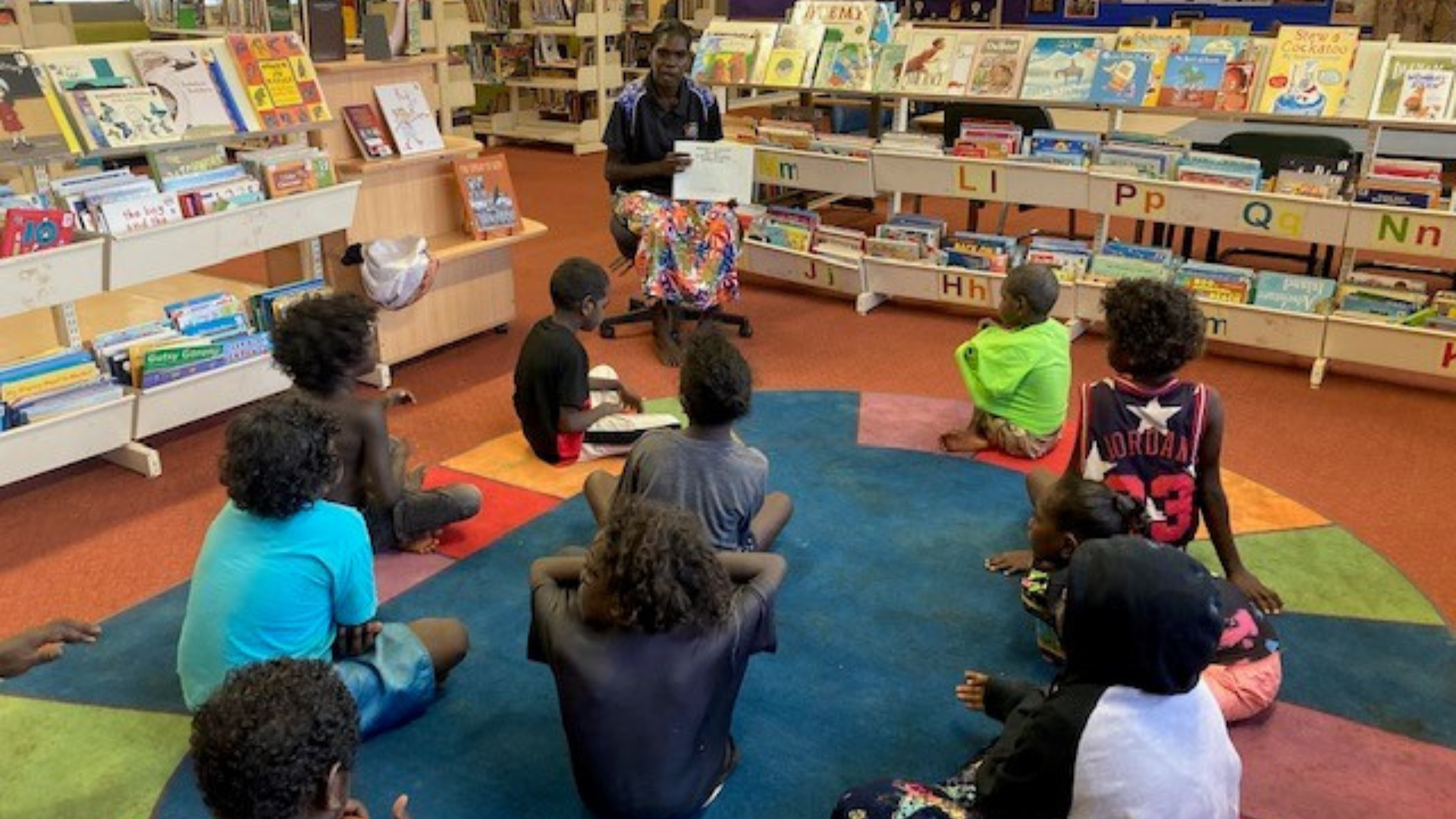
“Every time teachers come in with their class they straight away go to that area and start reading all the stories on the wall. And the kids settle while I tell them my story.”
Engaging with the younger members of the community in this way was a key motivation for Jacinta to begin working in the library in 2014.
“To me the library is like a knowledge centre, and I especially wanted to work with kids” she says. “I used to work as an assistant teacher in 2004 and 2010/11 and I wanted to engage with the community again.”
This desire to circulate stories, culture and knowledge within the community is something that Jacinta shares with other members of her family. Her mother worked at the Milingimbi Library in the late 80s and early 90s and her father and late grandmother she describes as strong and respected leaders within Milingimbi and the wider region.
Jacinta’s recollections of her grandmother are of a gentle, kind, and loving person who had a deep connection with the children of the area and believed that none of them should be left behind.
“Before school she would feed them porridge. They had to use a stone for a bowl and a shell for a spoon. Back then they didn’t have bowls. She was a very knowledgeable person. She taught people how to weave, how to make necklaces with shells and beads.”
There is a through line to be drawn here from the cultural teaching and nurturing practiced by Jacinta’s grandmother and Jacinta’s use of the library displays to address what she calls a lack of identity in the younger generation.
“I’ve put so much effort into the stories in the library for the sake of the kids - so that they can learn local history. Sometimes I worry because they seem to have a lack of identity, where they come from, which mob they belong to.”
Jacinta is especially interested in educating the students at the middle and upper primary level - grades 4 and 5 specifically. The stories she reads to them are based on the life of Yolngu People in Milingimbi and surrounding areas and are printed at the Milingimbi Literature Production Centre in local Yolngu Matha (‘Yolngu tongue’) - both Djambarrpuyngu and Gupapuyngu languages. Djambarrpuyngu, a Dhuwal language, is the main language spoken in North East Arnhem Land and Gupapuyngu language, also a Dhuwal language, used to be taught back in the days at school.
By sharing these stories in both languages, Jacinta hopes that the students will be empowered to teach their generations about the local history of Milingimbi and the people living on the island. “When you go home, please talk to your relatives, your family, to learn about your identity” Jacinta tells them “and while you’re still young, it’s much easier to learn and to be taught, and in the future you won’t lose interest in your own culture.”
Jacinta’s father, Lapulung Dhamarrandji, is similarly dedicated to passing on knowledge about Aboriginal history and culture. His image can be found on the wall of stories in the library where he stands with His Excellency the Governor-General of Australia David Hurley conveying his condolences on the passing of Her Majesty Queen Elizabeth II. He is pictured presenting the Governor-General with a cultural spear and woomera – a symbol of hope through a bridge of commonality within our shared nation. He did so as part of his duties as East Arnhem Regional Council President.
“My dad had a mission to teach his generation and others about Aboriginal culture. He left school when he was 16 and started working at Milingimbi School as a teacher before moving to Darwin and taking a job in the hospital. He then chose to do further studies at Batchelor Institute of Indigenous Tertiary Education and was studying to be an interpreter.”
According to Jacinta there were very few, if any, interpreters in the region at that time who could act as a bridge between those who spoke the local language and those who didn’t. Upon his return to Millingimbi rather than resuming his former job in the school, he took a job with the Council where has remained ever since.
His work does not end there, however. Jacinta’s father is part of the Wirrinyga Band, who have released two successful albums– Dreamtime Shadow and Dreamtime Wisdom Modern Time Vision. The band members are Yolngu and they sing in both Language and English and they mix modern instruments with traditional.
Whilst Jacinta says she has not inherited any particular aspirations as a musical performer, she has undoubtedly shared her father’s skill in expressing cultural experience, wisdom, hope and expression through music and lyrics.
“I wrote a song that I really wanted to sing because it comes from my heart, and I want all of Australia to hear it because it’s about justice. The song title is ‘Where is the true justice?.’ It asks how we can build that bridge together to make one human nation, to walk hand in hand.”
When asked if she would share the lyrics in this magazine, Jacinta readily agreed.
“I would like to share them in the magazine because then, instead of singing it, people could put the lyrics on the wall. The song is about reconciling all nations.”
‘Where is the true justice?
Every day I see my people struggle.
The First Nations People of this land.
How can we build that bridge and connect our cultures?
And where is the real reconciliation to reconcile all walks of life?
Together as one human race.
Remember, we are not different, we are all the same.
Our blood runs the same.
Where is the true justice in this land called Australia?
There hasn’t been change
it’s still the same
and I wonder why our people are quickly dying.
All we want is freedom in our own fertile land.
When will we get our recognition as the first people of this land in all states and two territories?
We, the Indigenous people of Australia, have connections to the land, sea, sky and everything that holds by land.
Our songlines, our stories, and our spirit, connect to the land.
It’s about time that you people
our brothers and sisters
open up your minds,
heart,
spirit
and soul.
Then let treaty, peace and hope deep inside you
by accepting us as your own kind
for a better future.
Remember, we’re no different, we’re all the same.
Our blood runs the same.
Towards the end of the conversation talk turns to the other services and support provided by the Milingimbi Community Library.
“All sorts of people come here seeking help, especially when they are struggling with online and internet banking, email, and things like that. I help them with emailing, writing letters to banks, providing identification online – that sort of thing.”
When asked what kind of training and support would be most useful in continuing to offer and to build upon these services, Jacinta makes the point the geographic location and reliable internet connection can often be a hindrance to taking advantage of professional development opportunities.
“I would like to upgrade my skills, doing library work. I would love to learn more about libraries. But travel to those places (Darwin or Nhulunbuy) by plane is too expensive.”
A bigger and more immediate challenge is reliable internet, not only in terms of online learning for library staff, but also in providing basic services for patrons.
“The internet hasn’t been working since earlier this year. We’ve reached out for IT support but it is still not resolved and we need the computer up and going for people to use.”
Another challenge for Jacinta is staffing. “I work by myself nearly every day, and that is very hard for me to deal with. People from the community give me a lot of work to help them out but is hard with low levels of staff.”
These are challenges faced by many regional and remote library services. The 2023 Australian Digital Inclusion Index found that there is a considerable digital gap between First Nations and non-First Nations people in Australia. The gap is particularly pronounced in remote locations. Outcome 17 from the National Agreement on Closing the Gap provides that ‘Aboriginal and Torres Strait Islander people have access to information and services enabling participation in informed decision-making regarding their own lives’. To achieve this Outcome, regional and remote libraries need reliable internet services, targeted support through training grants for library staff and increased budgets for staffing and developing collections.
The phrase ‘the power of storytelling’ is by now an all-too common often used in the Western tradition to demonstrate or explain the value of individual people and products. But for this library storytelling is defined by its relationship to a sense of completeness, reconciliation and identity, both in personal and collective contexts. We see this in the display on the library wall which brings together past and present in mutually reinforcing ways. We hear it in the stories, skills and cultural knowledge passed down by Jacinta’s father and grandmother, and in the lyrics of Jacinta’s song – one which calls for the reconciliation of all walks of life.”
A sense of completeness is a hope she has for herself and her own story, too.
“I would really like my story to be out there” she says. “It would make me feel whole.”
0 Comments