
Originally published in INCITE Magazine Volume 45, Issue 4
I freely admit to a love of mysteries and have been the butt of many a gentle jibe for endlessly rewatching Agatha Christie adaptations. Therefore, it has been fascinating to be involved in a real-life rare book mystery for the past couple of years. The book once belonged to 19th century palaeontologist Mary Anning and in 1985 made its way into the Museums Victoria Library, where I am library manager, to support museum research.
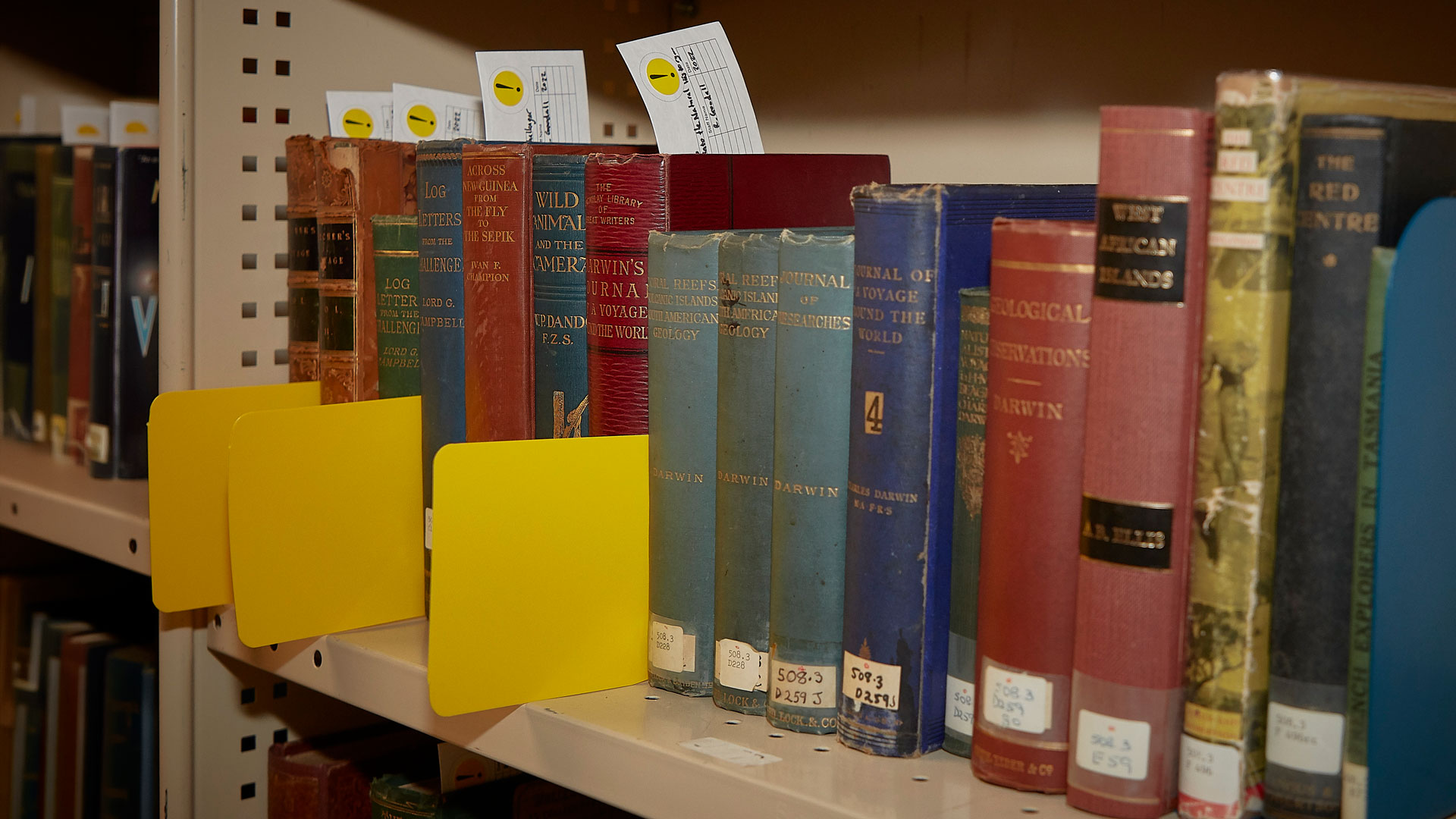
The Museums Victoria Library has a fantastic collection of natural history books due to early purchasing by the museum’s first director, Frederick McCoy. McCoy was an armchair naturalist and, some might say, spendthrift, who invested £80,000 setting up the museum in his first decade as director. Only a small portion of that went towards the library, but the £3,500 that was spent on books and journals was a significant investment that has stood us in good stead over the decades. The library has continued to develop since the 1850s and is best known today for some of the beautiful and rare natural history books collected by McCoy.
In the 1970s and 1980s, a second museum administrator took an interest in developing the library. As Deputy Director, palaeontologist Tom Darragh filled gaps in the collection, leafing through antiquarian book sellers’ catalogues, talking to museum experts, and bidding at local auctions to acquire rare books. A Natural History of the Crinoidea by John Samuel Miller (1821) was purchased from Oxford book sellers Blackwells as part of this collection development. The work was known to have belonged to Dorset fossil dealer Mary Anning, however it was acquired for research purposes rather than the association to Anning.
Historic texts are central to the work of museum taxonomists, who use them to trace the history of an animal’s classification. Increasingly, older scientific works are accessible in online repositories such as the Biodiversity Heritage Library. Our copy of A Natural History of the Crinoidea wasn’t being actively used for research by the time I started to investigate its provenance in 2021. The Treasures of the Natural World exhibition was due to open at the Melbourne Museum, and excitingly it included a lot of material that related well to our Rare Book Collection.
The exhibition highlighted the work of Mary Anning, and suddenly the rare book that she once owned was of interest again, this time as an artefact rather than a reference. Anning is significant for having made some of the most important geological discoveries ever known. She discovered extinct marine reptiles such as the first ichthyosaur and plesiosaur known to Western science, and her discoveries fed into the development of evolutionary theory. She built up a successful fossil dealership, and interacted with many leading scientists of her day, including JS Miller, author of A Natural History of the Crinoidea and curator of the Bristol Institute. As a working-class woman, however, she operated on the fringe of scientific discourse, unable to join the scientific societies that fostered professional networks, supported publication of new ideas and recognised members’ contributions to science.
Anning owned few books, which were an expensive commodity in this period. Some of her academic acquaintances presented her with copies of their journal articles, while she laboriously copied others out by hand. I expect she was grateful to receive the inscribed copy of A Natural History of the Crinoidea from Miller when he gave it to her with the dedication 'To Miss Mary Anning with the author's best wishes'. Anning met Miller through her fossil collecting work, and several of Anning’s fossils were acquired by the Bristol Institute during Miller’s curatorship. Miller visited Lyme Regis in 1824, and the two corresponded directly in 1830 over a fossil fish specimen that she unearthed, named Squaloraia by Henry Riley. Anning correctly identified the fossil as new to science.
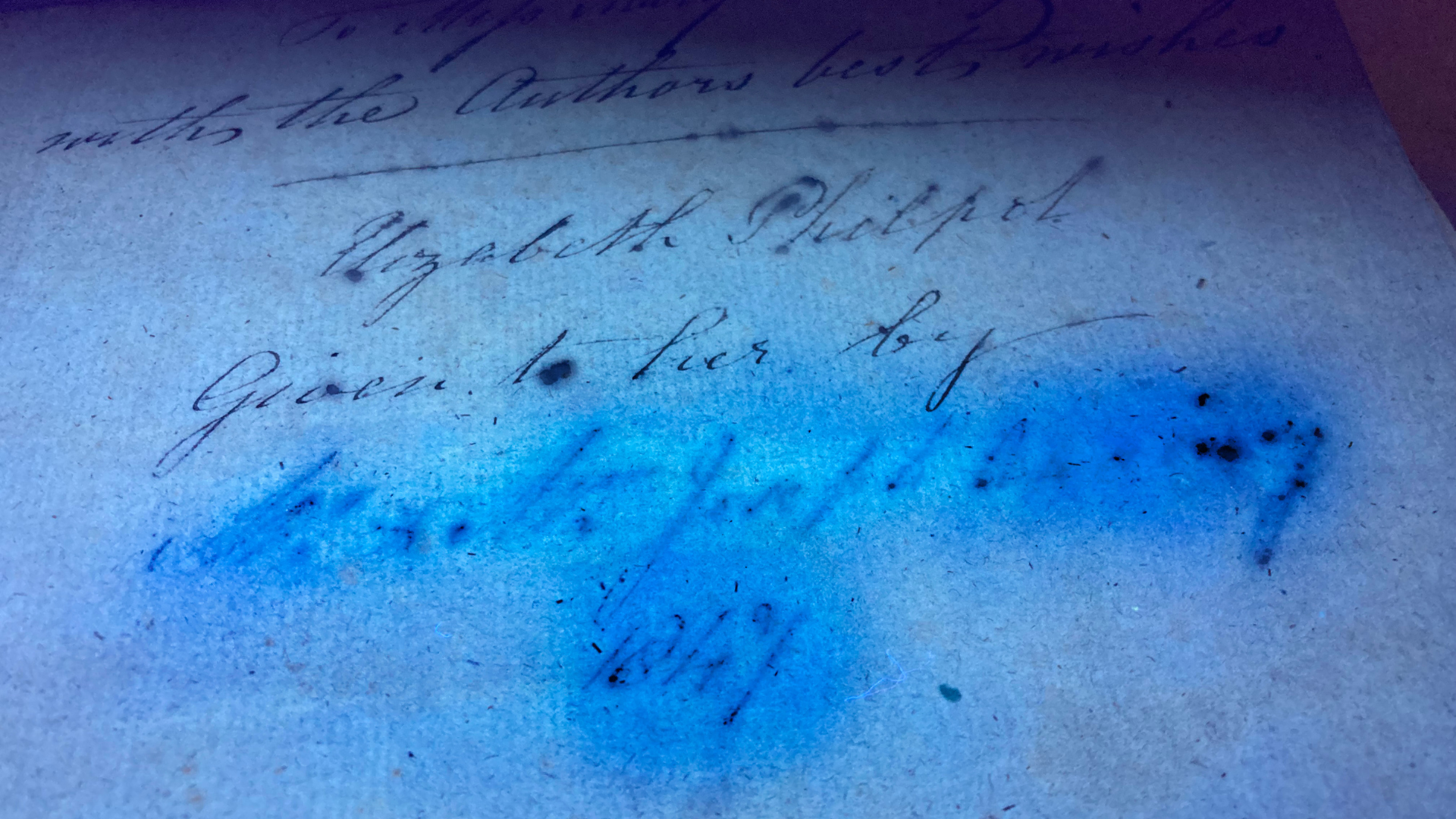
I had seen the 2020 film Ammonite, which highlighted Anning’s difficult and painstaking work collecting and preparing fossils. The film depicted Anning with female love interests, showing a blossoming relationship between her and geologist Charlotte Murchison, and alluding to an old romance between Anning and another Dorset collector, Elizabeth Philpot. I was intrigued to see a second inscription on our rare book underneath the one from Miller: ‘Elizabeth Philpot, given to her by…’ The rest of the inscription was missing.
Unfortunately, as with other collectible items, there is a trade in stolen rare books. This occasionally warrants media attention, such as the dramatic 2017 case that involved members of an organised crime group abseiling into a London warehouse to steal significant rare books by Galileo and Isaac Newton. It is enough of an issue that the International League of Antiquarian Booksellers (ILAB) has created a Database of Stolen and Missing Books to track stolen items.
Evidence of prior ownership in rare books is something that researchers, librarians and many collectors now take a great interest in. However, that wasn’t always the case, and, unless a work had a significant former owner, ownership marks such as inscriptions, bookplates and marginalia were often removed. This was also the case for stolen books, where these marks might be used to identify a particular copy of a work. A common way of removing handwritten text was ‘washing’, which involved washing the paper with bleach until the ink faded.
The history of queer or lesbian women is one where erasure also features prominently. Occurring outside the socially sanctioned bond of heterosexual matrimony, historical evidence of same sex relationships is comparatively scant. In a Western context, if romantic relationships between women were acknowledged they were routinely demonised and pathologized, while family members or authorities actively suppressed material evidence of queer relationships.
A Natural History of the Crinoidea had clearly been tampered with, and I wanted to know what the missing inscription said. The paper conservator and I took a photo of the inscription in a darkened room under UV light. We still couldn’t make it out, so one of our imaging staff enhanced the photo until I could read the words “Mr & Mrs Joseph Anning” and the date: 1847. It seemed that when Anning died in 1847 of breast cancer, her brother gave the book to Elizabeth Philpot as a memento.
Anning and Philpot were known to be close friends, and although Ammonite is fictional, it takes inspiration from real possibilities. In searching for a ‘hidden’ lesbian past, historians have pondered ‘romantic friendships’ and studied figures who challenged gender norms. Anning is certainly interesting as an example of a woman who defied convention by pursuing a career as a fossil collector, and contemporary descriptions of her could be seen as suggestive. Explorer and naturalist Ludwig Leichhardt described Anning as “a strong, energetic spinster of about 28 years of age, tanned and masculine in expression.” Palaeontologist Gideon Mantell called her “a prim, pedantic vinegar looking, thin female; shrewd, and rather satirical in her conversation.” These types of descriptions resonate if you are used to listening for silences and reading between the lines.
I wondered what had happened to the book after Philpot owned it. Anning’s biographer Tom Sharpe thought that the book was sold with Anning’s papers in 1885 by her nephew Albert Anning. Sharpe thought the book lost; the last he knew of it was from a Bristol book dealer’s 1983 catalogue.
In 2022 we released a video showing how we uncovered the missing inscription in Mary Anning’s book. It was seen halfway around the world by staff at the Lyme Regis Museum in Dorset, and they got in touch to let us know that the book was missing from their collection. They explained that the book had been donated to the museum in 1929 by a relative of Elizabeth Philpot. The museum had suffered a period of decline from the 1930s to 1970s, and during that time the book went missing.
We returned the book in May this year, in recognition of the significance of the item to Lyme Regis. It has been on public display in the museum, close to the sites where Anning made her discoveries. With the information from Lyme Regis, the whole ownership history of the book was known. But why was part of the inscription erased? The two logical reasons that suggest themselves are that someone wanted to obscure the ownership history or that they wanted to obscure something about the relationship of the people involved.
The erased text did not prevent the book from being identified once the Lyme Regis Museum knew its location. The main identifying feature was that it was owned by Anning with an inscription by the author. Elizabeth Philpot’s name was also retained, which tied in with the donation information from Lyme Regis. The erasure of Joseph Anning and his wife from the inscription removed the lesser-known figures from the picture. The date of the gift at Anning’s death suggests that Philpot and Anning were close – but this was already known.
The repatriation of Anning’s book has been an interesting experience on a few levels. Professionally, it was illuminating to be involved in an ownership claim and reassuring to work in an institution that prioritises ethical practice. Throughout the process, though, my mind has continued to return to the implications of erasure. This was the first question a historian of sexuality asked me when I presented on the return of the book recently, finding the erased text as suggestive as I had. I remembered a queer colleague excitedly visiting to see the inscriptions to Anning and Philpot; the book has a queer aura. It brings to mind Margaret Middleton’s interpretive strategy ‘queer possibility’ which argues that lived experience is valid interpretative expertise, and that museums should resist double standards around proof of gender or sexual identity, and allow for different, queer ways of reading objects.
Objects can have different meanings in different contexts or to different people. Anning’s copy of A Natural History of the Crinoidea is significant as a tangible, material object once owned by an important historical figure, and it is right that the book has returned to the place where she has so much significance. Having been the treasured item of two female 19th century palaeontologists, and the subject of deliberate erasure, it is also significant for the questions it invites and ability to hint at a possible queer past.
0 Comments