
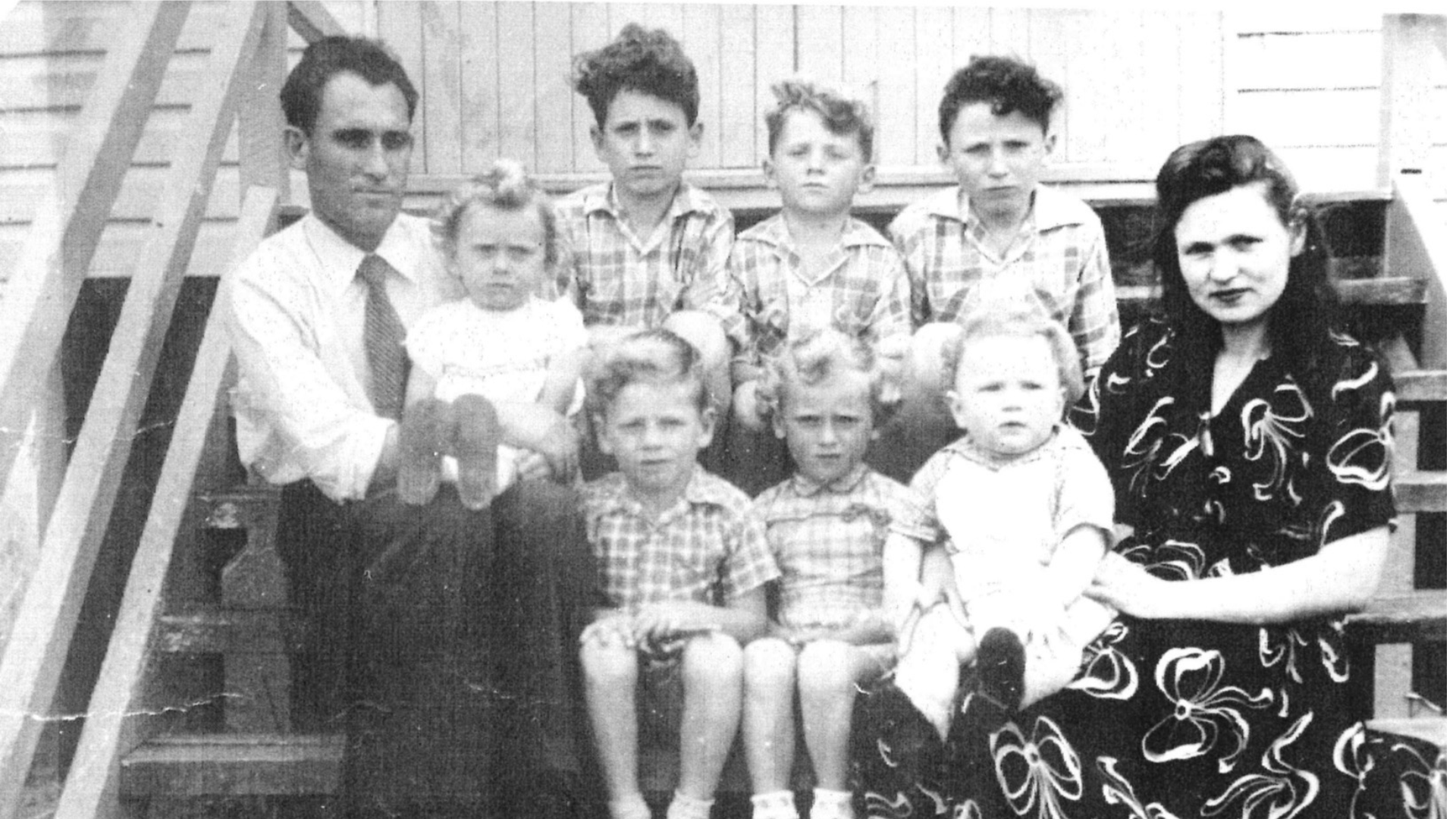
Behind every migrant family history is a trail of half-remembered truths, myths and legends, requiring good detective work to uncover the facts. This is the story behind the story of Felicia Djamirze’s true crime memoir Accessory, co-written with award-winning journalist Erin O’Dwyer.
How do you reconstruct a family’s past when memory, myth, and history overlap – and all of it matters? Some stories are remembered. Others are inherited. And some live in the uncertain space in between. But when you’re writing a true history for commercial publication, myth isn’t enough. Only verifiable fact will do.
When my research assistant and I first headed out to Blacktown RSL, in Sydney’s western suburbs, in August 2024 to interview our client Felicia Djamirze’s 80-year-old uncle – Alexander ‘Safic’ Djamirze – we weren’t just on a fact-finding mission. We were gathering the raw materials – the building blocks, you might say – with which to craft Felicia’s true crime memoir, Accessory.
While Accessory tells the story of Felicia’s extraordinary life as a beauty queen turned gangland girlfriend turned convicted drug dealer turned trauma counsellor, it also charts her family’s migrant story which includes her paternal Russian/Ukrainian grandparents’ journey to Australia as World War II refugees with three small children. It also traces her European colonial, African American slave and Australian Aboriginal heritage on her mother’s side.
Felicia’s uncle, Safic, held much of the family story in his mind: part first-hand memory, part family history, and some in the hazy space in between. Felicia’s sister, Aminette ‘Chiba’ Djamirze – now in her 50s and some 16 years older than Felicia – has remarkable knowledge of the Djamirze family tree too. They trace it all the way back to their royal lineage as Circassians: an Indigenous people of Muslim faith from the Caucasus Mountains, which lie between the Black Sea and the Caspian Sea, near present-day southern Russia.
A nearly perfect memory
If you’ve ever worked on a biography or family history, you’ll know memory and facts don’t always add up. Research by American psychologist Elizabeth Loftus has shown how quickly memories bend and blur. But even flawed memories are highly valuable. They give you a place to start – a thread to tug on. Turns out, that’s all we needed.
Over coffee and cake in the courtyard of Blacktown RSL, Safic and Chiba told us that their family were WWII refugees, who made their way from England to Australia in 1949 on the SS Orontes. Safic would have been five years old. He had strong memories of being at the Bonegilla Migrant Camp near Wodonga in Victoria. And he told us that the family ultimately returned home to the USSR, because his mother was homesick, when he was 14.
That’s where the story ended and our job as historical detectives began. Our mission? To find corroborating or contradicting evidence of the Djamirzes’ migrant journey to Australia, then back home to Russia, and then back to Australia again – the final time in the 1970s.
Spelling mistakes and small clues
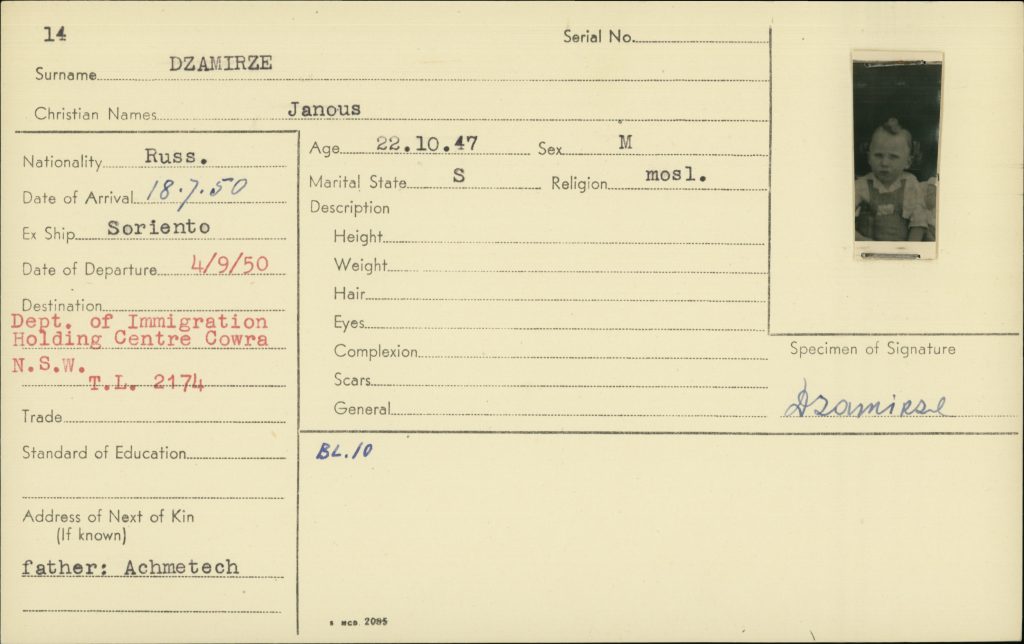
Our first stop was the Bonegilla Migrant Experience database. Each person or family group at Bonegilla was registered with an identification card which recorded dates of arrival and departure, the ship or flight they came on, the block they lived in and more. Today Bonegilla’s website has a searchable function, which will bring up a downloadable file of the original identification card. Other research avenues open to us were the National Archives of Australia, and the National Library of Australia’s Trove newspaper archives.
The only catch was that keyword and database research requires precise spellings. We had already done a quick search for ‘Djamirze’ and ‘D’Jamirze’ (as some of the family spell their name) at Bonegilla – no luck. Did that mean Safic had misremembered Bonegilla? We knew family names mutate, especially uncommon ones like Djamirze (pronounced djah-MIR-zay). After a painstaking search through pages of names – 93 results out of more than 300,000 Bonegilla migrants – we turned up a match. There she was at last: Valentina Szamirze, born in Russia in 1926 – complete with ID card, a photo, and a record of arriving in 1950 on the Soriento (not Orontes). We had uncovered one small spelling error which became our first tiny data point – and suddenly the first piece of the puzzle fell into place.
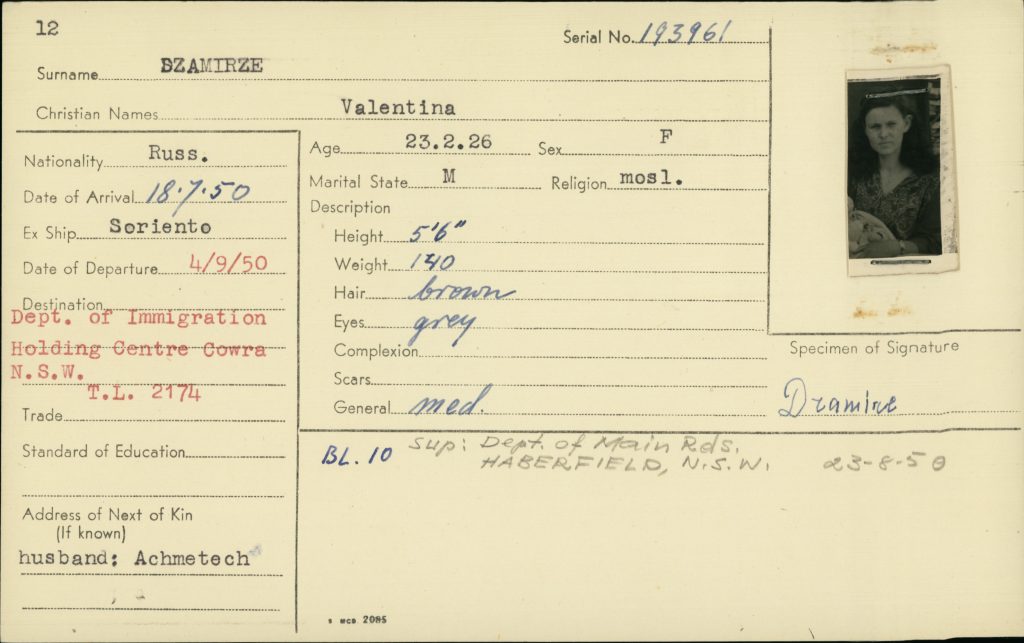
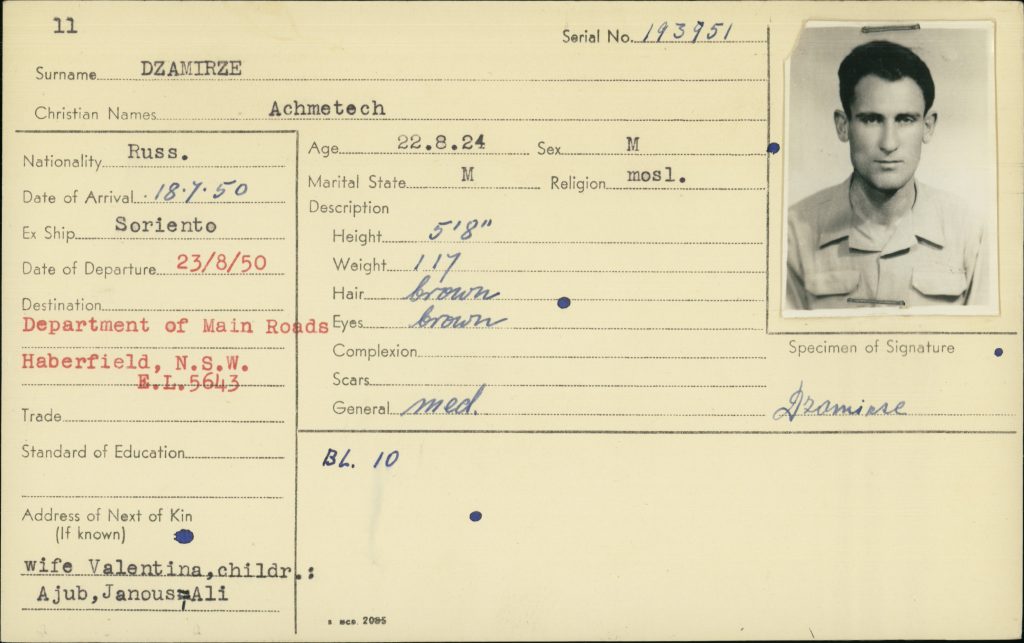
The spelling of Valentina’s last name with an S was likely a typo, as the scan of her ID card reveals it was actually spelt incorrectly then fixed later – with the S replaced with a D, Dzamirze. (The online search functionality still had her name starting with an S but has since been fixed at our request.)
Valentina’s ID card named her husband Achmetech – also misspelt, the correct spelling is Akhmetech – as her next of kin and included a black and white photo of 24-year-old Valentina holding a baby, who would have been her third son Alick. We had already seen a photo of Valentina – a framed one Safic had brought with him in a shopping bag. She was a beautiful raven-haired woman with Greta Garbo styling. And even on the tiny black and white ID card photo, her beauty was striking. This was definitely her.
Once we found Valentina and Akhmetech – Felicia’s paternal grandparents – the rest of the family revealed themselves more easily. Two adults and three children – Safic, Felicia’s late father Yuri and her late uncle Alick – were interned at the Bonegilla Migrant Camp. We already knew from Safic that Valentina and Akhmetech had moved around looking for work after the war. Safic was born in Rome, Yuri was born in Reggio Emelia, and Alick was born in Syria.
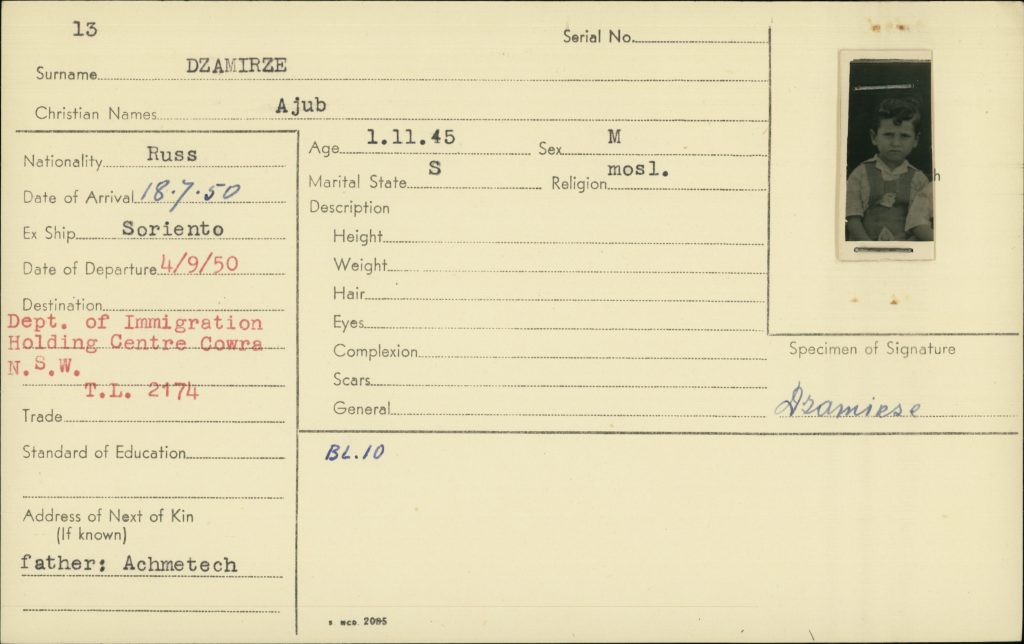
But as we searched the archives we were in for a surprise – the three children were registered with completely different given names. Alexander (Safic) was Ajub, Yuri was Janous, and Alick was Ali – their last link to their father’s Circassian Muslim faith.
This was not the end of our ID card adventures. In order to reproduce the cards and correctly cite them, we needed to find them in the National Archives of Australia. The NAA gives each card a series number and an item number, by which they can be cited. Valentina’s surname was also misspelled there, but this time at least we were armed with the two alternative spellings.
The Bonegilla camp ID cards gave our investigation three more leads. The name of the ship the family had arrived on – Soriento. The date they’d arrived – 18 July 1950. And the spelling of their family name at the time – Dzamirze.
A story that was nearly never uncovered
It was not the last case of human error giving modern-day family history sleuths a bum steer. Contrary to the Bonegilla records, the ship the family had arrived on was actually called Surriento, not Soriento. The next piece of the puzzle was figuring out the Surriento’s port of departure and port of arrival. Trove was the next place to look.
In 1950, without mobile phones or the internet, the ‘shipping news’ – published in daily newspapers – was how people kept tabs on friends and family at sea. Melbourne’s The Sun News-Pictorial reported the arrival of the Surriento from Genoa, Italy on Tuesday, 18 July 1950. On board would have been five exhausted Dzamirzes. The trip from Europe to Australia took four to six weeks, depending on route and weather. And the ship had departed Italy – not England, as Safic remembered. (The family would later return home via England nearly a decade later, so Safic was correct; his memory had just confused the circumstances.)
More time searching Trove, and the puzzle’s true picture began to emerge. After being sent from Bonegilla to Cowra Migrant Camp, the family then made their way to Greta Migrant Camp, near Newcastle. The Singleton Argus reported a certain Valentina Dzamirze had assault charges filed against her after she got into a scuffle with several women at the Greta Migrant Camp in 1953. The charges were dismissed. Five years later, an August 1958 story in The Canberra Times titled ‘Russian Family on Way Home From Australia’, reported Achmetech (sic) and Valentina Dzamirze and their now eight children were travelling ‘home’ from Australia to the USSR.
It was so unusual for migrant families to return to their communist homelands after the war that a wire service journalist from the Australian Associated Press (AAP) interviewed them and wrote up the piece. They were homesick and excited to return to the newly formed Soviet Union, the story explained. Safic filled in the blanks – Stalin was gone, and Valentina wanted to see her elderly parents before their eventual death. She had not seen them since she was a 15-year-old, taken by the Nazi invaders from her home in Mariupol (now Ukraine) and shipped off to domestic labour in Germany. Akhmetech had also been displaced from his hometown, Krasnodar – in present-day southern Russia – as a 20-year-old after Nazi invasion. They met in a refugee camp in Vienna in 1945. Neither had been home since the war began. The AAP story said they were returning with eight children aged one to 12 – a family large enough to catch a journalist’s eye, even back then.
After returning to the USSR, the large family grew even more: Valentina and Akhmetech had three more children there. But some 20 years later, homesickness – this time for Australia – drew them back across the globe again. The eldest children, Safic and Yuri, convinced the Soviet administration to grant them visas on the basis of ‘nostalgia’, and they returned to Newcastle, where they got jobs in the steelworks. The brothers worked triple shifts to save enough money to bring the rest of the family - now 13 in all – back to Australia by the end of the 1970s. Valentina and Akhmetech’s 11 children went on to raise their own families in Sydney’s western suburbs, and many of the third generation still live there with their own children.
Why the smallest details matter
What happened to the family when they returned to the USSR – and how they eventually made their way back to Australia in the late 1970s – is detailed in Felicia’s book.
But what this goes to show is the real work of writing memoir, biography or family history isn’t just about interviewing the main players and capturing what people remember. It’s about testing those memories, cross-checking stories, spelling every name three ways, and following each lead until the fragments line up. The archival research didn’t just confirm what we’d been told – it told us much more than the history keepers in the family, namely Safic and Chiba, knew or remembered. It also uncovered a deeper, truer and more complex story that made for a far more compelling book. The resulting book is not only about Felicia and her migrant family but also about Australia’s migrant history and the resilience, reinvention and hidden stories that shape who we are today.
Writing memoir, family history and biography is slow, and requires patient, painstaking, behind-the-scenes detective work. But with the smallest clue, you can uncover the full story. And, ultimately, make sure memory is supported by facts.
Erin O’Dwyer is an award-winning journalist and the director of Good Prose Studios. She is the co-author of Accessory, with Felicia Djamirze (Affirm Press, 2025). Ina Holzapfel served as the research assistant on Accessory
0 Comments