
How does collecting political flyers and other ‘throw-away’ items contribute to democracy? Why do we keep collections of political ephemera in Australia? What kind of stories might these items help us to tell? These questions and many more were discussed by Nathan Hobby (Curtin University Library) Kathryn Dan (Noel Butlin Archives, ANU), and Conor McCarthy (National Library of Australia) in the ‘Discovering Democracy’ session during last year’s Library and Information Week. In this special From the Archive, Nathan Hobby expands upon his presentation by delivering into a particular story about ephemera and democracy that leapt out at him from the collection at the John Curtin Prime Ministerial Library: the propaganda battle in the 1916 conscription referendum, told through letters and notes John Curtin wrote on the back of anti-conscription flyers he was distributing.
The Western Australian Institute of Technology became Curtin University of Technology in 1987, named in honour of John Curtin (1885-1945), who was Prime Minister of Australia during the Second World War. To mark the new identity for the institution, the University established Australia’s first prime ministerial library, which opened to the public in 1998. In developing a new collection, we sought material about John Curtin from around the world and received many significant letters, documents, photographs, books and artefacts, including a
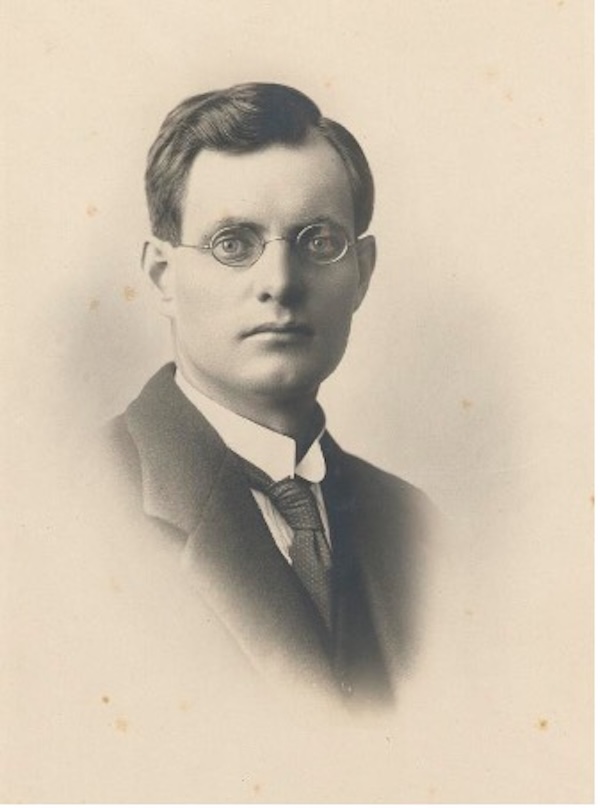
donation from the Curtin family of letters written to them by John Curtin.
When the Great War began in1914, many Australians volunteered to enlist with the Australian Imperial Force. However, by 1916, the death toll was high, the war had no end in sight, and there were no longer enough volunteers enlisting. Labor Prime Minister Billy Hughes attempted to gain a mandate to conscript young Australian men to fight, despite the opposition of his own party, and the conscription referendums (more correctly, plebiscites) in 1916 and 1917 were key events in Australia’s (more correctly, plebiscites) in 1916 and 1917 were key events in Australia’s political history. The heated debate about conscription during the referendums divided not just the Labor Party but Australia as a whole and tested our democracy, especially the nation’s commitment to freedom of speech.
John Curtin, then thirty-one years old, was one of the leaders of the anti-conscription campaign in Victoria. Recognised as a powerful orator, he had been working as a union organiser but the campaign came in a difficult period of his life—he had just spent two months in a sanatorium for alcoholics in Lara, near Geelong. The propaganda battle was central to the anti-conscription campaign, as seen in this letter he wrote to his fiancée in Tasmania, Elsie Needham, on 14 October 1916, two weeks before the referendum:
We are fighting this battle with our hands tied & our mouths gagged. Every newspaper opposed to us can say what it likes:- all the papers on our side are censored out of existence. We cannot get a poster passed, an article unaltered. So it is a case of desperate remedies. From Monday we will—in addition to the paper activity—circulate vast quantities of leaflets which will not be submitted [for censorship]. It is a work of supreme difficulty. There are only four men who know the nature of the leaflets & only one knows where they are printed. Distribution is a stupendous task & one possible because of the wonderful loyalty of our army of men & women who in the hour of difficulty have sprung to life. (JCPML00402/13)
The distribution of posters and leaflets is an important way to exercise freedom of speech in a democracy, but there have been moments in Australia’s history like this one where it has been under threat.
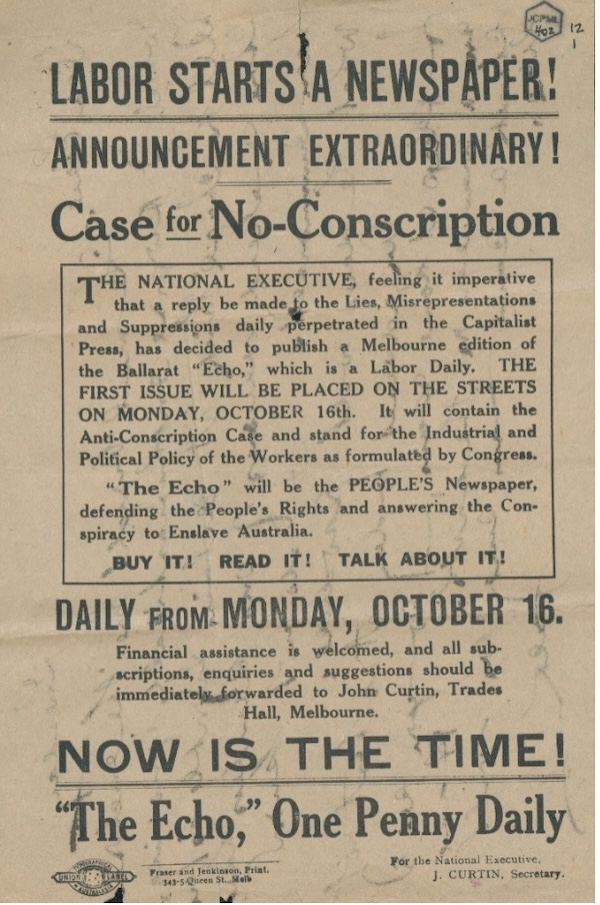
The ephemera itself is only preserved in our collection because Curtin wrote four letters to Elsie on the back of flyers, including on multiple copies of a flyer titled ‘Labor Starts a Newspaper’. The labour movement had decided to distribute copies of the Ballarat Evening Echo in Melbourne. It was a four-page daily newspaper, edited by another future prime minister, James Scullin, and it was one of the few newspapers opposing conscription. On the back of one of them, Curtin wrote, ‘Police just raided two printers and are on their way here. We are off.’ It is a vivid example of the curtailing of free speech. (JCPML00398/5)
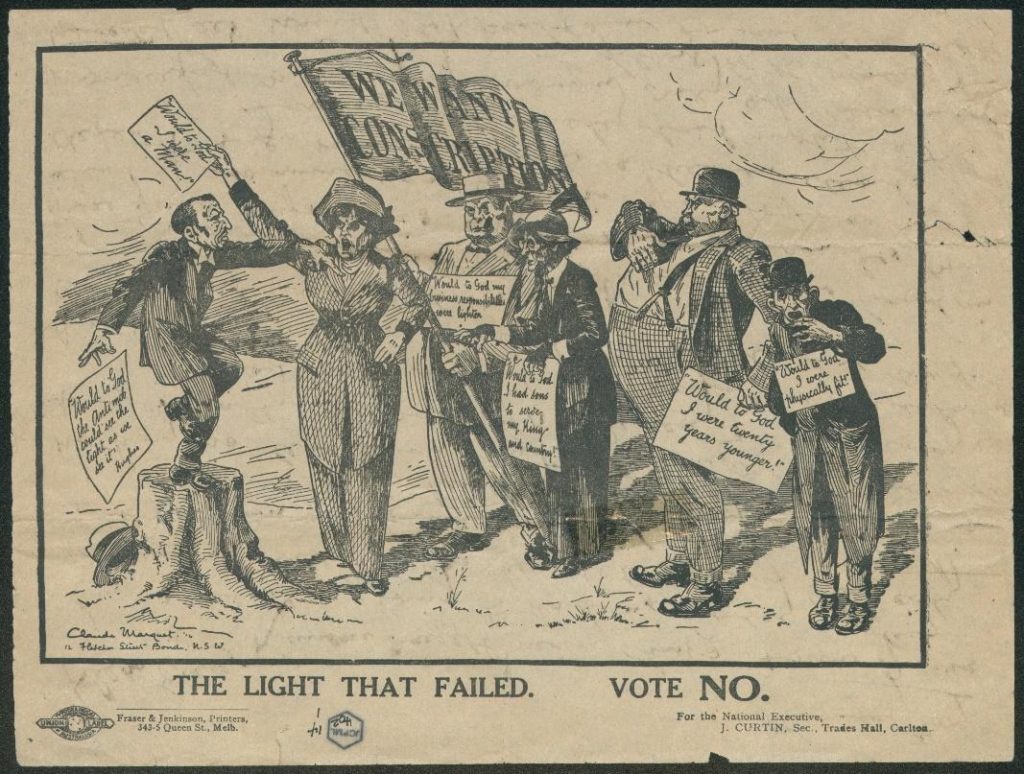
The campaign used humour for this cartoon flyer, with the pro-conscriptionists each holding up an excuse why they themselves would not be fighting: the woman who would fight if only she were a man; the businessman who wishes his business responsibilities were lighter; and the moustached man who wishes he was twenty years younger. Curtin wrote on the back of this one, ‘Our last newspaper is on the streets so nothing is left to do but clean up the fagends & generally prepare for Friday & Saturday. We have issued our final instructions & only an immense variety of battle-eve leaflets await distribution.’ (JCPML00402/14)
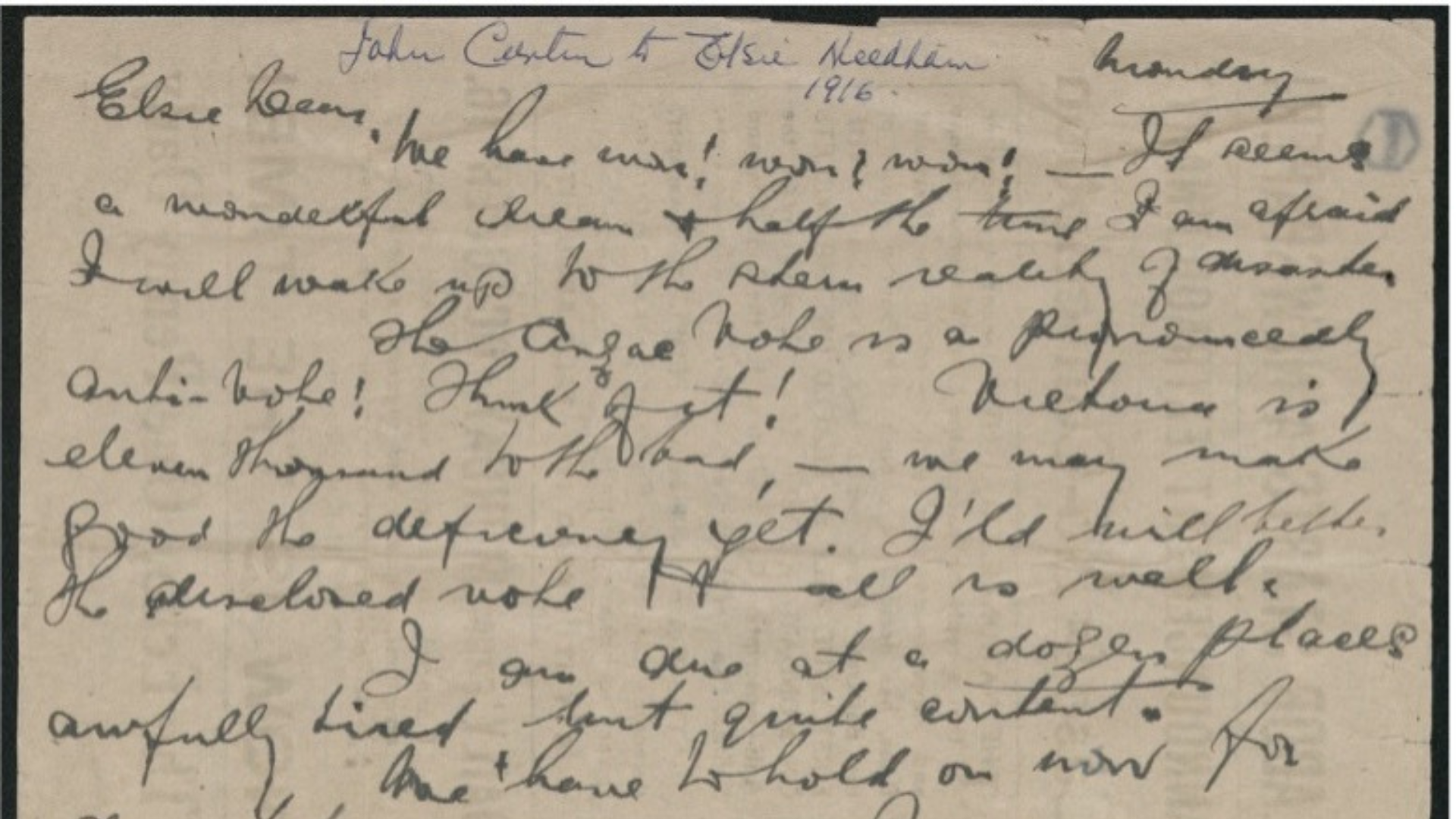
Dating a few days later, we have another copy of the ‘Labor Starts a Newspaper’ flyer with Curtin writing after the 28 October referendum, ‘We have won! Won! Won! It seems a wonderful dream and half the time I am afraid I will wake up to the stern reality of disaster.’ (JCPML00402/15) The referendum was indeed narrowly defeated nationally. Three states voted ‘No’ and three states, including Victoria, voted ‘Yes’, with a nationwide vote of 51.61% for ‘No’.
However, there was not much opportunity for Curtin to celebrate. During the campaign, Curtin had written on the back of another copy of the ‘Labor Starts a Newspaper’ flyer that he intended to ‘enthusiastically ignore’ his call-up notice for compulsory military training. (JCPML00402/12) Despite the defeat of the referendum, prosecutions continued against men who had refused to report for training. After failing to appear in court in November, he was sentenced to three months’ prison and a warrant was issued for his arrest. For three weeks, Curtin moved from house-to-house evading arrest. When the police finally caught up with him, he served three days in the Melbourne Gaol before the Minister for Defence ordered his release.
This brief story of democracy through flyers is, of course, incomplete because democracy relies on us hearing both sides of the story. Thankfully, a number of libraries in Australia have built wide-ranging collections encompassing pro-conscriptionist ephemera as well, including a collection of posters digitised by the State Library of New South Wales.
The rest of Curtin’s career had resonances with his role in the anti-conscription campaign in 1916. In 1917, he moved to Western Australia to become the editor of the Westralian Worker, continuing what he unabashedly saw as ‘propaganda’ work. (‘Strictly speaking, Labour weeklies are not newspapers—they are propagandist sheets,’ he wrote in 1921, ‘Their business is to convert and to confirm…’) Later, as a politician, one of his great achievements as Opposition Leader from 1935 was to unify a party which had been torn apart by Conscription and then the crisis of the Great Depression. Ironically, as Prime Minister in December 1942, he put his leadership on the line in pushing his party to agree to send conscripted Australian troops outside Australia into the south-west Pacific area.
In Martin Andrews’ essay, ‘The Importance of Ephemera’, he writes, ‘[I]tems of ephemera … can throw a very particular light on history, offering not only factual detail but also an atmospheric and evocative direct link with the past.’ John Curtin’s hastily scrawled notes on the back of the material at hand give us a sense of the intense time he was living through. The accidental preservation of the ephemera which meant so much to the campaign adds an extra dimension to this critical moment of strain in our democracy.
In recent decades, the historical value of ephemera has been widely recognised and libraries and archives are now intentional about collecting it. In doing so, we are fulfilling one of our most important functions in a democracy: to be the collective memory for a society, remembering accurately what was written, drawn, printed, photographed, or recorded, including the throw-away items with revealing details which are so easily forgotten.
Works Cited
Andrews, Martin. ‘The Importance of Ephemera’. In A Companion to the History of the Book, 434–50. John Wiley & Sons, Ltd, 2007. https://doi.org/10.1002/9780470690949.ch32.
Curtin, John. ‘The Labor Press and “The Worker”’. Westralian Worker, 16 December 1921, p. 4.
Personal correspondence of John Curtin Family, John Curtin Prime Ministerial Archive, Curtin University, JCPML00402.
Personal papers of John Curtin Family, John Curtin Prime Ministerial Archive, Curtin University, JCPML00398.
0 Comments