
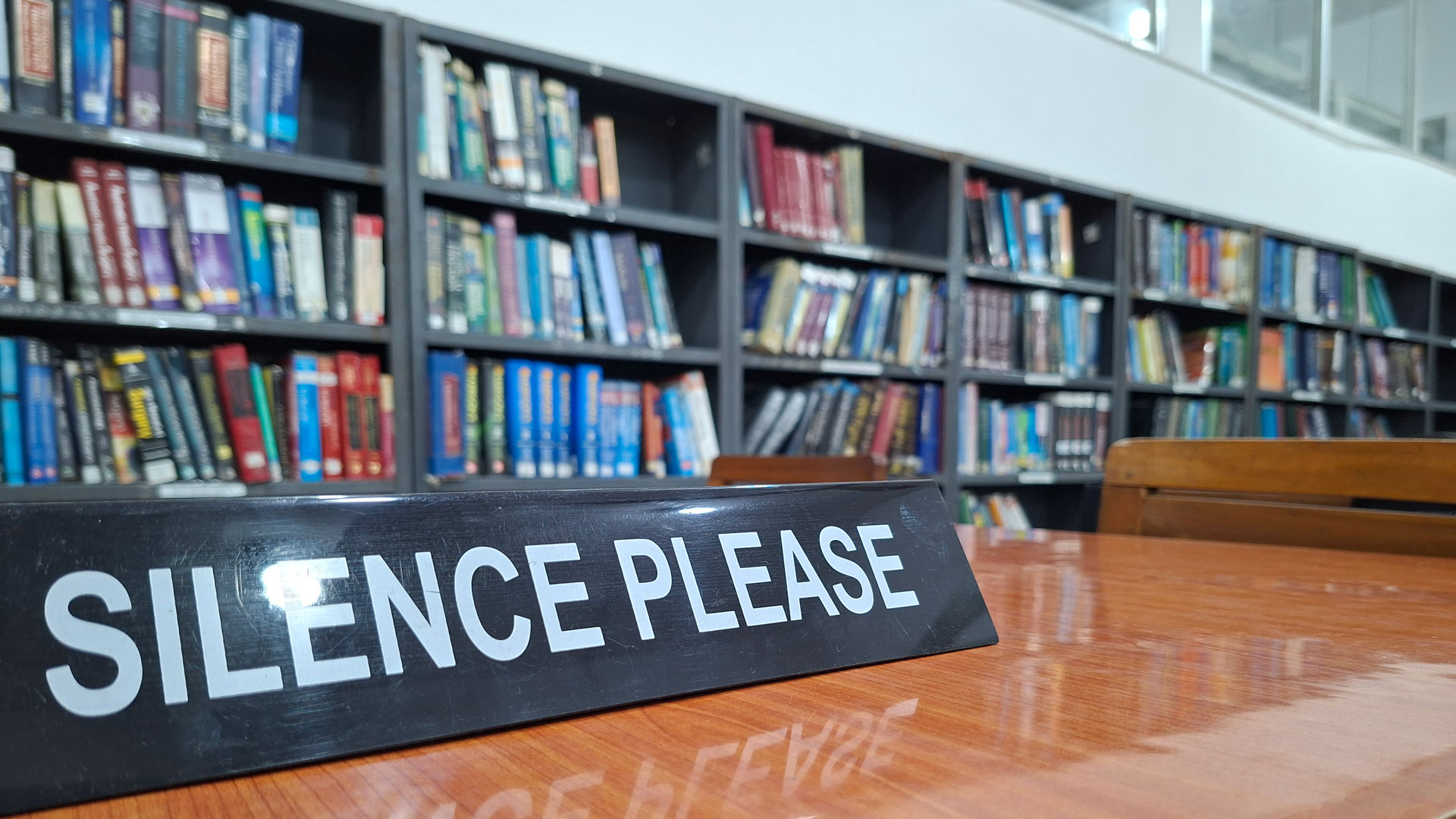
A while ago, I came across an online article in the Washington Post with the catchy title “It’s okay for libraries to be loud! Take it from me, a librarian.” In it, Karen McPherson, a staff member at a public library in the US, described being shushed by a patron. Clearly amused at this reversal of traditional roles, she went on to claim that contemporary libraries are no longer “citadels of silence” but are instead more like “bustling community centres” – and that this is a good thing.
The idea that noise is now something that should be tolerated (or even encouraged) in libraries is obviously far from a minority perspective. Many industry professionals have been extolling the virtues of noisy libraries for at least the past decade or two, particularly within the public library sector, with some arguing that it is old-fashioned, if not entirely anachronistic, to advocate for quiet libraries.
Proponents of this recent shift often seek to emphasise the ways a relatively laissez-faire approach to noise may create a more welcoming, friendly and relaxed environment, as well as foster improved opportunities for social interaction. Oldenburg’s influential idea that libraries can and should be “third places” in which visitors of all ages and backgrounds can connect in a relaxed way with others in their communities (1999) has helped drive the ever-expanding calendar of (sometimes noisy) community events, clubs, discussions, workshops, and other activities that often occur in contemporary public libraries. Similarly, the social, emotional and educational benefits during early childhood of chatting, singing, reading aloud, and participating in other (relatively) noisy activities (Shaw, 2021; Killen & O’Toole, 2022) have also long been recognised in widespread and well-established public library programs such as Rhymetime.
In some libraries, the increasingly hands-off approach to noise may also have been influenced by more pragmatic factors, such as concerns about the best allocation of scarce staff resources. After all, it takes time and energy to monitor and enforce noise restrictions - time and energy that might be better spent on provision of any number of other services. As entertainer Kitty Flanagan has sardonically pointed out, most contemporary library staff are delighted they no longer have to spend their time “stalking around the book stacks and appearing out of nowhere to angrily shush anyone who dare[s] to so much as whisper” (2019, p286). Nobody wants to monitor the decibel-
Even so, not everyone agrees that increasingly noise-tolerant libraries are unequivocally a positive thing. Of the hundreds of comments that were posted in response to McPherson’s Washington Post article, for example, many correspondents expressed reservations about the author’s assertion that a noisy library is inherently a happy library; one concerned individual pointed out that “some people … may go to the library to escape noise they experience elsewhere” and asked “why do family-oriented activities, instruction, training, and other activities have to supplant the traditional role of the library as a place for serious research, study, and reading?” A similar sentiment was perhaps the motivation behind anonymous feedback given to “the most loudest library ever” by an unhappy public library patron in Western Australia in 2017, while others have written about their nostalgia for the days when libraries were “hallowed sanctuaries of silence”.
Why are these library users so dismayed at the non-interventionist approach to noise in contemporary libraries? For some, it may simply be due to a general hankering for the sort of quiet environment that used to be the specialty of public libraries, the very thing (yes, in addition to their collections of books!) that made them distinct from other public places. After all, it can be difficult to find places that are reliably quiet, particularly in cities. This issue was explored in the 2007 film Noise, with Tim Robbins’ protagonist driven to extreme acts of vigilantism in protest against the incessant noise he is forced to endure in Manhattan. It is not hard to imagine that some critics of noisy libraries simply yearn for a place where they can escape the sometimes overwhelming sounds and stimulation of everyday life.
Other advocates of quiet libraries may be drawn to their utilitarian benefits. Some library users may need a calm and quiet environment in order to complete a task that requires concentration (and for some, this calm and quiet environment may not be accessible elsewhere – even at home). Studies have repeatedly shown that too much noise can make it more difficult to comprehend written information, as well as to remember, analyze and evaluate it (eg Braat-Elgen et al, 2021; Yadav & Cabrera 2019; Shield & Dockrell 2008; Evans & Lepore 1993;). This is perhaps why professional tennis players and students completing high stakes exams typically prefer a quiet environment when trying to showcase their best work. Some of the greatest writers and thinkers from history have also been among the most passionate campaigners against excessive noise. Modern computing pioneer Charles Babbage as well as writers Tennyson, Dickens and Forster all lobbied vigorously for legislation against noise in 19th century London (Goldsmith, 2012). While noise may enhance the performance and productivity of a small number of people (van der Groen, 2019), such people really are the exception to the rule according to psychologist Nick Perham of Cardiff Metropolitan University who says “most people work best when it’s quiet”.
In recognition of the different and sometimes mutually exclusive preferences of their users, some library managers have been resisting either/or approaches to noise, and have instead attempted to strike a happy medium. For example, some public libraries offer designated quiet times and/or spaces to patrons. Unfortunately, offering quiet spaces is not possible in all libraries due to their open-plan design and/or their lack of sufficient floorspace, while designated quiet times may be difficult to properly maintain (not to mention labour intensive) in a culture in which enforcement may be viewed as officious and overbearing (a fact which may be complicated by the use of inherently subjective words such as “quiet”).
In this context, the reality is that the onus may often be placed on those library users who prefer a quiet environment to simply sort it out for themselves. They can find a quiet spot in the library and hope it stays that way, they can purchase a set of noise-cancelling headphones (if they can afford them), or they can put up with the noise. Alternatively, of course, they can simply choose not to go to the library in the first place.
While it may be neither realistic nor desirable to wind the clock back to the days when librarians were de facto noise police, contemporary library managers should nevertheless continue to consider all their users – including those who want or need a quiet environment - when developing their approaches to noise management.
References
Armitage, C. (2012). Silence is not so golden in the modern library. The Sydney Morning Herald. https://www.smh.com.au/education/silence-is-not-so-golden-in-the-modern-library-20120305-1ueed.html
Black, M. & Shaw, S. (2017). ’The most loudest library ever’: booklover goes the way of shushing staff as community hubs take hold. ABC News. https://www.abc.net.au/news/2017-05-24/loud-libraries-signal-move-to-role-as-community-hub/8555112
Braat-Eggen, E., Reinten, J., Hornikx, M., and Kohlrausch, A. (2021). The effect of background noise on a “studying for an exam” task in an open-plan study environment: A laboratory study. Frontiers in Built Environment, 7, 687087.
Evans G, Lepore S. Nonauditory effects of noise on children: a critical review. Child Environ. 1993;10:31–51.
Flanagan, K. (2019). 488 Rules for Life : the Thankless Art of Being Correct. Allen & Unwin.
Goldsmith, Mike. Discord: The Story of Noise, Oxford University Press, Incorporated, 2012. ProQuest Ebook Central.
Gorvett, Z. (November 19, 2019). Why office noise bothers some people more than others. BBC. https://www.bbc.com/worklife/article/20191115-office-noise-acceptable-levels-personality-type
Gunders, P. (2016). “A loud, vibrant community space with fewer books: welcome to the library of the future.” ABC News. https://www.abc.net.au/news/2016-02-26/welcome-to-the-toowoomba-library-of-the-future/7201456
Heath, N. (2019). Public libraries are not just about books: at their heart they are about social equity. The Guardian. https://www.theguardian.com/commentisfree/2019/may/10/public-libraries-are-not-just-about-books-at-their-heart-they-are-about-social-equity
Killen, R., & O’Toole, M. (2022). Effective Teaching Strategies : Lessons from Research and Practice. (8th ed.). Cengage Learning Australia.
McPherson, K. (2023). It’s okay for libraries to be loud! Take it from me, a librarian. The Washington Post. https://www.washingtonpost.com/books/2023/05/12/noisy-library-defense-essay/
Oldenburg, R. (1999). The great good place : cafes, coffee shops, bookstores, bars, hair salons, and other hangouts at the heart of a community. Marlowe.Sayer, M. (2019). Quiet please! On the frontier in an inner-city library. The Sydney Morning Herald.https://www.smh.com.au/entertainment/books/quiet-please-on-the-frontline-in-an-inner-city-library-20190430-p51ikj.html
0 Comments