
Adult non-fiction is where libraries stop sounding abstract and start making calls. This item or that one. Credible or crank. Solid synthesis or confident nonsense. Worth a place in a public collection, or not. These decisions happen every day, thousands of times, in every public library—and they are epistemic judgements whether we call them that or not.
I spent nine years researching those decisions. Not the policy framework around them, but the actual knowledge claims embedded in them: what makes a source reliable, what makes authority legitimate, how you build a balanced collection without pretending all claims are equal. The dissertation had a formal title about "epistemic factors in selection and evaluation," but the real question was simpler: on what grounds do we decide what counts as knowledge worth keeping?
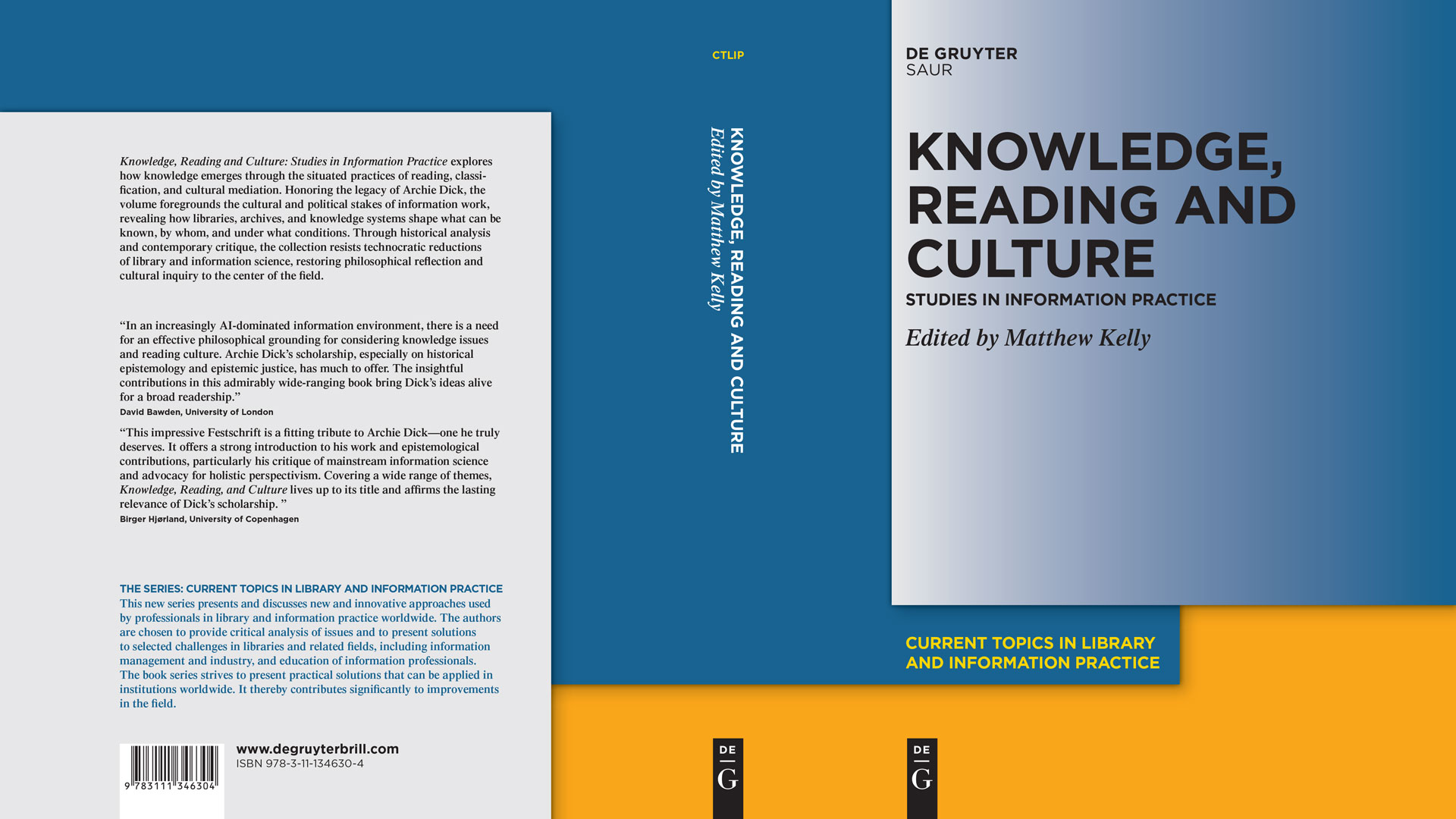
That question led to my recently released edited volume, Knowledge, Reading and Culture: Studies in Information Practice (De Gruyter Saur)—a collection honouring Professor Emeritus Archie Dick and extending his work on epistemology, reading cultures, and the intellectual foundations of library and information science.
Dick's contribution to the field is sometimes described as "philosophical," which makes it sound like optional enrichment. It is not. Dick insisted that epistemology is a professional discipline: the practice of examining your methods, testing your knowledge claims, and reducing error in what you certify as credible.
That matters because libraries do not operate in neutral territory. Every adult non-fiction collection contains persuasive nonsense alongside legitimate expertise. Every catalogue makes implicit judgements about what things are and what they are about. Every subject heading decides what becomes comparable, what becomes adjacent, what gets found.
If you cannot justify those decisions—if you are just following vendor recommendations and usage stats—you are not doing knowledge work. You are doing inventory management.
Dick also understood that reading cultures do not maintain themselves. They are social systems: shaped by what gets selected, what gets displayed, where reading happens, who gets taken seriously as a reader. Libraries are part of that system. What we make normal to read, what we make worth the effort, what we keep in print after publishers move on—those are cultural decisions about what knowledge remains alive.
A decade ago I edited (with Jared Bielby) a Festschrift for Professor Emeritus Rafael Capurro that pushed at the same problem from another angle: you cannot treat information as a neutral substance when meaning and interpretation are built into every encounter with a text. The two traditions connect. Dick insists libraries need epistemic standards. Capurro insists interpretation cannot be automated away. Together they point to the same conclusion: library work is knowledge work—or it is something less than it claims to be.
The contributors to Knowledge, Reading and Culture work that territory from different angles—epistemology and judgement, reading as orientation and agency, the institutional pressures that shape access and education. What connects them is not a manifesto but a standard: information practice that cannot defend knowledge is not a profession.
The digital shift did not create these problems. It made them undeniable.
When everything is instantly available, context disappears. When search ranking determines visibility, authority becomes whatever ranks well. When reading means scanning summaries, understanding gets replaced by the feeling of understanding.
This is not about nostalgia for card catalogues. It is about what happens when confidence travels faster than verification, when algorithmic curation replaces professional selection, when "access" means drowning in results that clarify nothing.
Under those conditions, knowledge organisation stops being background infrastructure and becomes the thing standing between a usable collection and an unusable one. Classification is not tidying. Description is not trivia. Subject analysis is not clerical. They are the intellectual work that makes knowledge retrievable, comparable, and meaningful.
And if we are not training people to do that work—if we are training them to manage platforms and workflows instead—then we need to be honest about what "library and information science" is supposed to mean.
Here is the practical test: Can a graduate from an Australian LIS program build a coherent adult non-fiction collection? Can they explain why one item belongs under this heading and not that one? Can they distinguish between credible expertise and persuasive fraud? Can they describe their selection criteria without hiding behind "community needs" or usage statistics?
If the professionals we are educating cannot answer those questions plainly, something has slipped—not politically, but intellectually.
Libraries are one of the last institutions designed to preserve knowledge rather than monetise attention. They can still create the conditions for sustained reading, for encountering sources with context, for comparing claims instead of picking the most confident one.
But only if the profession remembers that knowledge organisation is knowledge work—intellectual work that requires judgement, training, and standards.
Knowledge, Reading and Culture argues for taking that work seriously again. Not as heritage preservation, but as civic necessity. In a world where information is abundant and meaning is scarce, libraries matter exactly to the extent that they can still tell the difference.
Dr Matthew Kelly is CEO of the strategic information consultancy firm Library Management Australia and is a member of the editorial advisory board for the journal Collection and Curation.

0 Comments