
The Royal Agricultural and Horticultural Society of South Australia (RA&HS) traces its lineage to the very early years of South Australian colonisation, with an agricultural society forming in 1839. Prominent early colonists were directly connected to the establishment of the Society, with the Manager of the South Australian Company, David McLaren, its inaugural President. With South Australian colonisation being an overtly commercial exercise, the establishment of an agricultural society to improve cultivation of the land, and subsequently its value, was crucial to these commercial imperatives. Another agricultural society formed in 1842, and by 1844 local newspapers served as a forum to debate which of the two societies was “the” society. This is an area of some historical confusion, reflecting confusion at the time – members of the original society assumed a merger had already taken place. In 1846, formal agreement of a single entity named the Agricultural and Horticultural Society was established.
Throughout its existence, the Society and the Royal Adelaide Show have been a social and economic driver for South Australia, with the Royal Adelaide Show regularly the highest attended of the Australian Royal Shows on a per-capita basis. This history forms the foundation of the RA&HS Archives collection. However, the cultural impact of the RA&HS and the Adelaide Showground (formerly Wayville Showground), extends beyond these agricultural roots.
With a background in university and public libraries, I was familiar with collections whose range of subjects was theoretically limitless. An archive representing the history of a more singularly focused organisation naturally requires a more specific collection policy. However, it was evident the items collected over the years had almost exclusively focused on the Society and the Royal Adelaide Show, whilst items related to other events held at the Showground were lacking. There was little evidence of the huge music festivals held over the last 30-years, including the Big Day Out, which was held at the Showground 19 times between 1994 and 2013. The Big Day Out was the largest and most successful music festival in Australia for two decades yet save for some photos and commemorative beer cans, this history was largely absent. The history of the Showground as a significant musical site, however, precedes these festivals by decades.
Adelaide Showground’s Centennial Hall (built in 1936 and demolished in 2007), was a prominent live music venue, particularly from the 1950s to the 1970s. The Rolling Stones, The Beach Boys, Roy Orbison, The Who, Louis Armstrong, The Seekers, The Monkees, Bill Haley, The Kinks, Nat King Cole, and Bob Dylan graced the Centennial Hall stage, to name but a few. Most prominent of all Centennial Hall performances, however, was undoubtedly The Beatles. Not only are they the biggest band of all-time, their Adelaide visit is considered one of the most culturally significant events in Adelaide’s history, and it nearly didn’t happen.
Initially left off the Australian tour, an estimated 80,000 people signed an ultimately successful petition to bring the Beatles to Adelaide. A dispute between promotors and the RA&HS over the hire of Centennial Hall followed, with promoters threatening to remove Adelaide from the tour. John Martin’s (an Adelaide department store chain) subsequently agreed to sponsor the visit, and a mutually palatable fee was agreed upon with the RA&HS. This off, then on, then off, then on-again merry-go-round added to the fervour that greeted The Beatles when they finally arrived.
Before the Beatles in 1964, the Queen’s visit a decade earlier was arguably the largest South Australian welcome for an international guest. For Her Majesty’s visit, tens of thousands of school children were directed by the government to put on a show for the Queen at the Showground. The Beatles, on the other hand, received a public outpouring of emotion borne from a grassroots campaign to put on a show for Adelaide.
An estimated 300,000 people lined the streets from the airport to Adelaide Town Hall to see the Beatles motorcade, accounting for approximately 40% of Adelaide’s population – this was unprecedented for any band, in any city. Some students were given leave to view the Beatles, while others risked disciplinary action to witness their heroes. At one school, 200 students staged a sit-down strike after being forbidden from listening to the radio broadcast of the Beatles arrival.
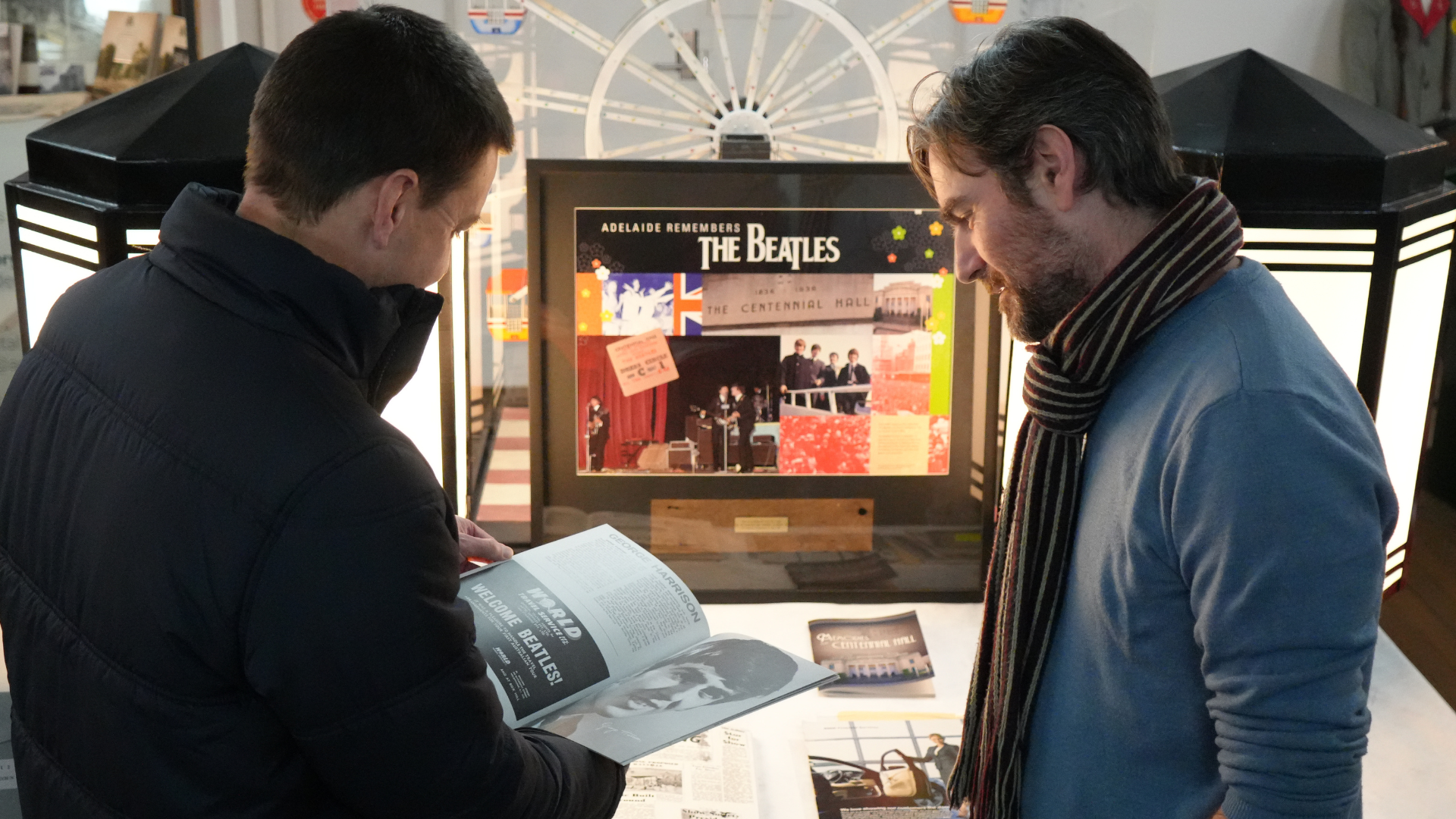
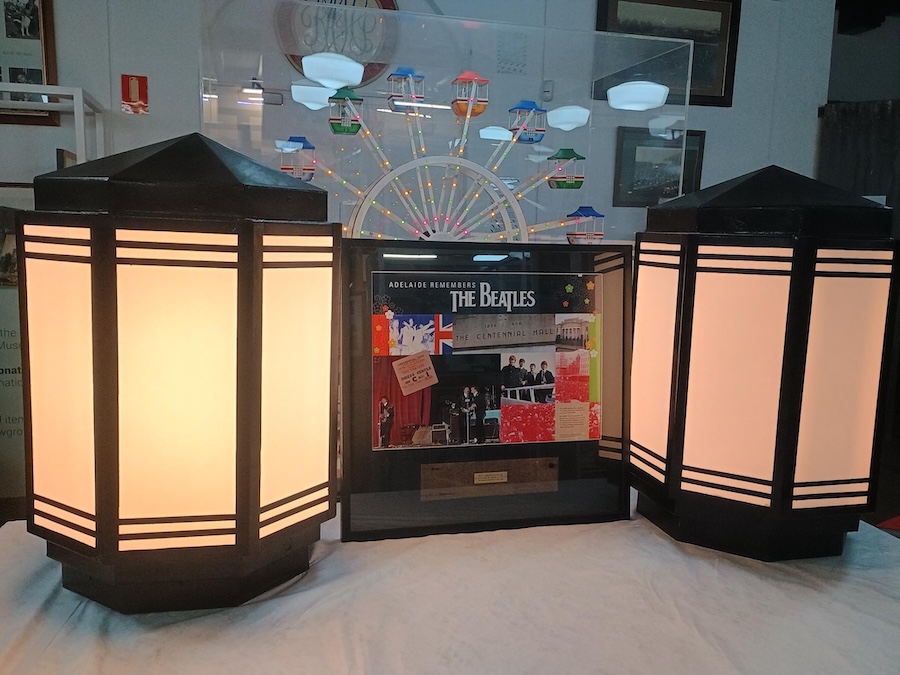
The Beatles visit to Adelaide was predicated on a suitable venue to perform. That venue was at Adelaide Showground, however, few related items existed in the RA&HS Archive. The collection consisted of newspaper cutouts, correspondence between the RA&HS and John Martin’s, and floorboards from the stage on The Beatles performed, which were framed as Beatles memorabilia to raise money for the RA&HS Archives Foundation. Items such as concert posters, ticket stubs, photographs, and merchandise were not collected. However, one rather unusual item was salvaged in 2007 during demolition - the urinal from the Centennial Hall green room.
It is unclear if this urinal was kept purposefully or set aside to be scrapped later. I first viewed the item 17-years after its removal from Centennial Hall. It was sitting unassumingly above the State Basketball Centre, which doubles as the Dog Pavilion during the Royal Adelaide Show.
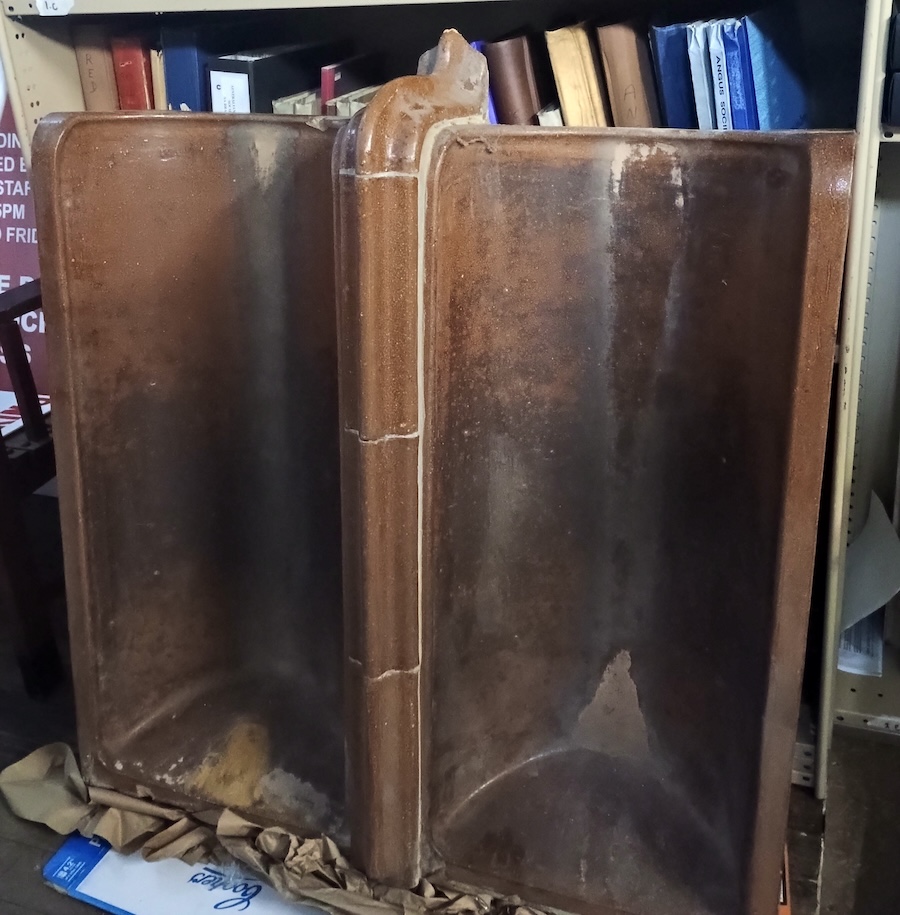
Some may question if this item is suitable for archival collection, whether for reasons of taste or historical significance. If part of the value of a historical item is to draw attention to the history it represents, “The Beatles Urinal” has justified its existence. During the recent 60th anniversary commemorations of The Beatles Adelaide visit, the History Trust of South Australia made a video to mark the occasion. Mention of the urinal caught the attention of the filmmakers and became a significant feature of the Adelaide Showground portion of the video. This video then led to a drivetime interview on ABC Radio a few days later, with all questions relating to The Beatles Urinal. At a recent social gathering of GLAM professionals, I was introduced to a librarian who responded, “You’re the Beatles Urinal guy!”
There are, of course, questions surrounding this item to be addressed – Did The Beatles use this urinal? Appropriately, no photographic evidence exists and thus it cannot be proven, but the answer is almost certainly yes given it was the only convenient facility for the four shows played over two days. Are The Beatles the only famous people to use this urinal? Definitely not. The list of famous performers that graced the Centennial Hall stage is a long one. Finally, the big question of whether this item belongs in our collection - the short answer is simple - if The Beatles (almost certainly) used something, you keep it. The longer answer is that the quirky, unconventional nature of the item, and the light-hearted appeal to toilet humour (quite literally), draws people to our collection and causes them to ponder the events, names and places connected to it. We have begun a process of collecting items that celebrate the rich musical history of the Adelaide Showground, including the recent acquisition of a collection of Big Day Out posters and programs. I hope to acquire items to build our Beatles collection, but regardless, The Beatles Urinal will continue to be an item of interest, and I humbly accept my custodial role as “The Beatles Urinal Guy.”
0 Comments