
There are over 2,000 special libraries in Australia, yet many of them are buried inside larger organisations and lack visibility. This is the challenge and opportunity of working in a special library – special librarians must tailor their skills and services to match their organisation’s mission or risk losing relevance.
It is for this reason and many others that I’m excited to take up the role of Government and Special Libraries (GaSP) Chair and represent this unsung part of the LIS sector. I’ve worked at Museums Victoria Library for over a decade and have lots of sector experience - the Museums Victoria Library is at once a government, special and museum library and includes a Rare Book Collection to boot.
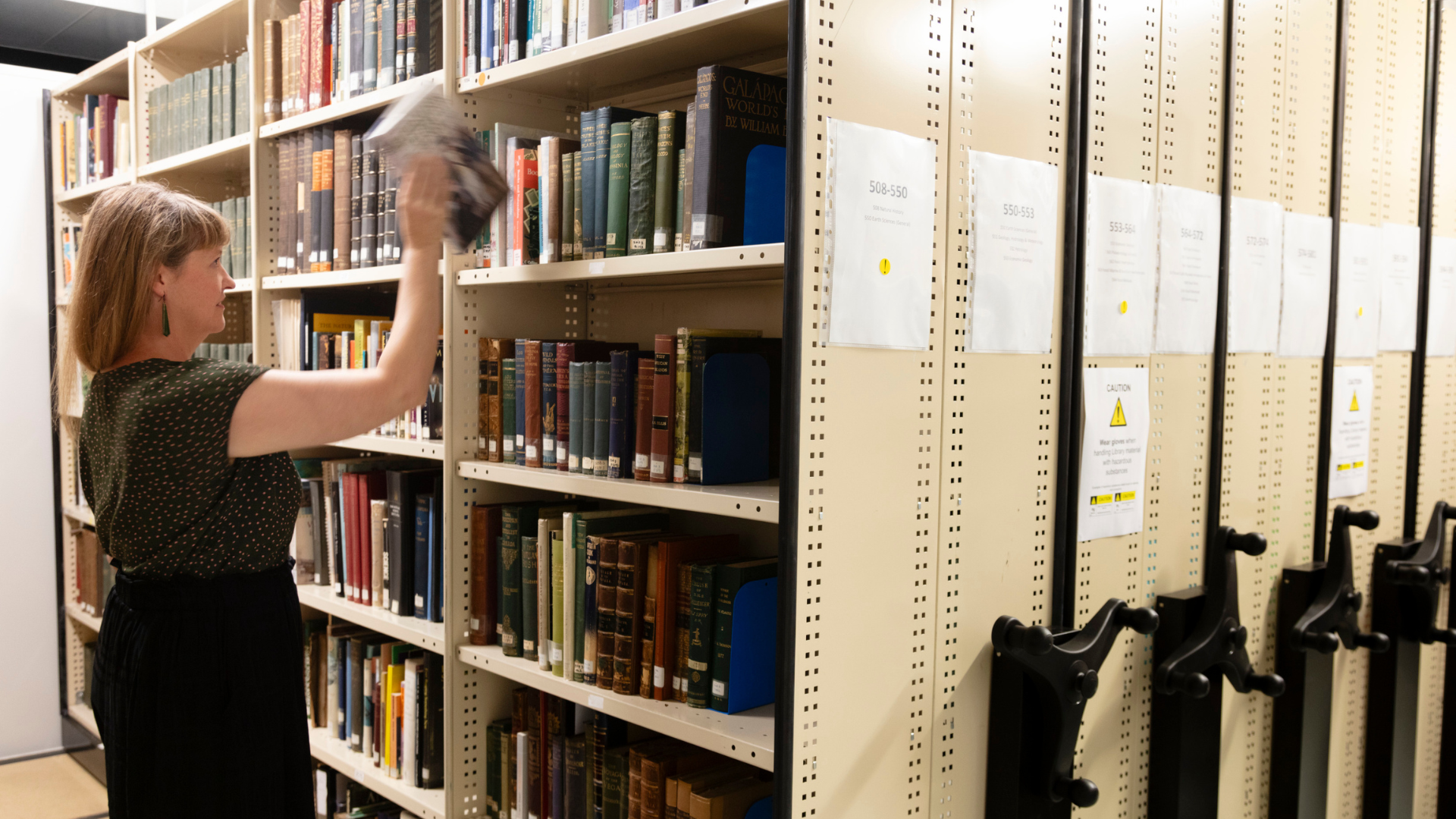
The library I work in is over 170 years old but was not well known to the public until recently. We have boosted our visibility by leveraging digital technologies and our beautiful Rare Book Collection. Through sharing our holdings to Trove and WorldCat, digitising scientific texts for the Biodiversity Heritage Library, ensuring a presence on our organisational website and social media channels, contributing to Museums Victoria Collections and making our online catalogue publicly accessible, we have opened up our collections like never before. We have drawn on our historic Rare Book Collection for marketing, commercial projects and programs such as Melbourne Rare Book Week. We are not replicating public or state library services; rather, we contribute to the research, storytelling and digital initiatives that our organisation prizes. I believe visibility is one of the greatest barriers for government and special libraries – it is difficult to advocate for libraries that few people see, and for a sector in which the libraries are so markedly different from one another. Special and government libraries lack the strong identities of public, academic and school libraries. Is there an opportunity to shape one?
Even for a library inside a research institution, where the library’s connection to research should be obvious, it is imperative to prove value and alignment. The Museums Victoria Library plays a pivotal part in supporting the organisation’s role as a trusted source of knowledge by providing library services to our researchers. Like many special and government libraries, we rely on our extensive resource sharing networks to provide access to information outside the scope of our collections. We provide high quality and equity-based metadata and support Museums Victoria’s mission We place First Peoples’ living cultures, histories and knowledge at the core of our practice through reparative cataloguing and reclassification. Our programs and digital projects contribute to the museum’s mission We are innovative in creating captivating experiences within and beyond our walls.
However, as Dr Katherine Howard points out in ‘The unique role and value of information professionals in special libraries’ (2017) it can be difficult to quantify the value of special libraries. A 2014 report ‘Putting a value on 'priceless': an independent assessment on the return on investment of special libraries in Australia’ attempted to do just that, indicating there was a $5.43 return for every $1 invested, with health libraries returning $9 for every $1 spent. Librarian Gemma Steele pointed to the importance of marketing in her 2018 conference paper ‘Marketing and promotion of special libraries and collections: methods, vehicles and activities’. Metrics and strategic planning also play a role, and ALIA provides some useful resources for special libraries experiencing a service review and the implications of closing a government library service on their website.
Another challenge for the sector is the tendency for isolation, with many small teams or solo librarians powering government and special libraries. After delivering an extensive 5-year Marketing Plan, my focus has now shifted to networking, with my team and I playing an active role in the profession through a range of ALIA Special Interest Groups and other activities. This ensures that we are connected to the latest information in our profession, are sharing what we know back to our networks, and maintain our hard-won visibility. Networking was the clear antidote to the professional isolation I experienced earlier in my career as one of few librarians in an organisation with an amazing amount of professional diversity. I hope that I can help to facilitate connection through my role as GaSP Chair.
While it remains one of the most elusive parts of the Library and Information profession, former GaSP committees have been active in advocating for this sector. A 2018 Special Libraries Summit highlighted three priorities: Advocacy, Mutual Support, Research & Best Practice. Metadata, managing born digital information, digital preservation, information literacy, learning & development, special collections, and digitisation emerge as themes for discussion from this group. I’m curious to know more about the impact of technology on special libraries – while technology is often posed as a threat to library work, the other side of the coin is that our profession has the skills to assist organisations to navigate ethical use of AI, promote information literacy in an age of mis and disinformation and manage the explosion of digital information. The Australian Computer Society's ACS Digital Pulse 2024 stated that recruiting workers from adjacent fields will be crucial for meeting an anticipated demand of 1.3 million additional ICT professionals by 2030. While many of us work in libraries because this aligns with our values, and do not necessarily want to change professions, this demonstrates there is a niche within librarianship that could support the growing need for ICT skills in the economy.
Special libraries spring from the people and culture of the broader organisation that they form part of and often have unique collections and interesting stories to tell. I think it’s a shame that these collections and their talented staff are not as well known as they could be. Whether they be in museums, art galleries, wineries, prisons, health providers, legal firms, government agencies or centralised government services, the diversity is what makes this such an interesting sector, and, although challenging, my experience working in a special library is that it provides rich opportunity and professional breadth.
Want to learn more about GaSP and the world of special libraries? Join us for a webinar 'The Value of Specialised Libraries and Information Services' on Wednesday 24 June 2026, 12:30 pm to 1:30 pm AEST. Register here.



0 Comments