
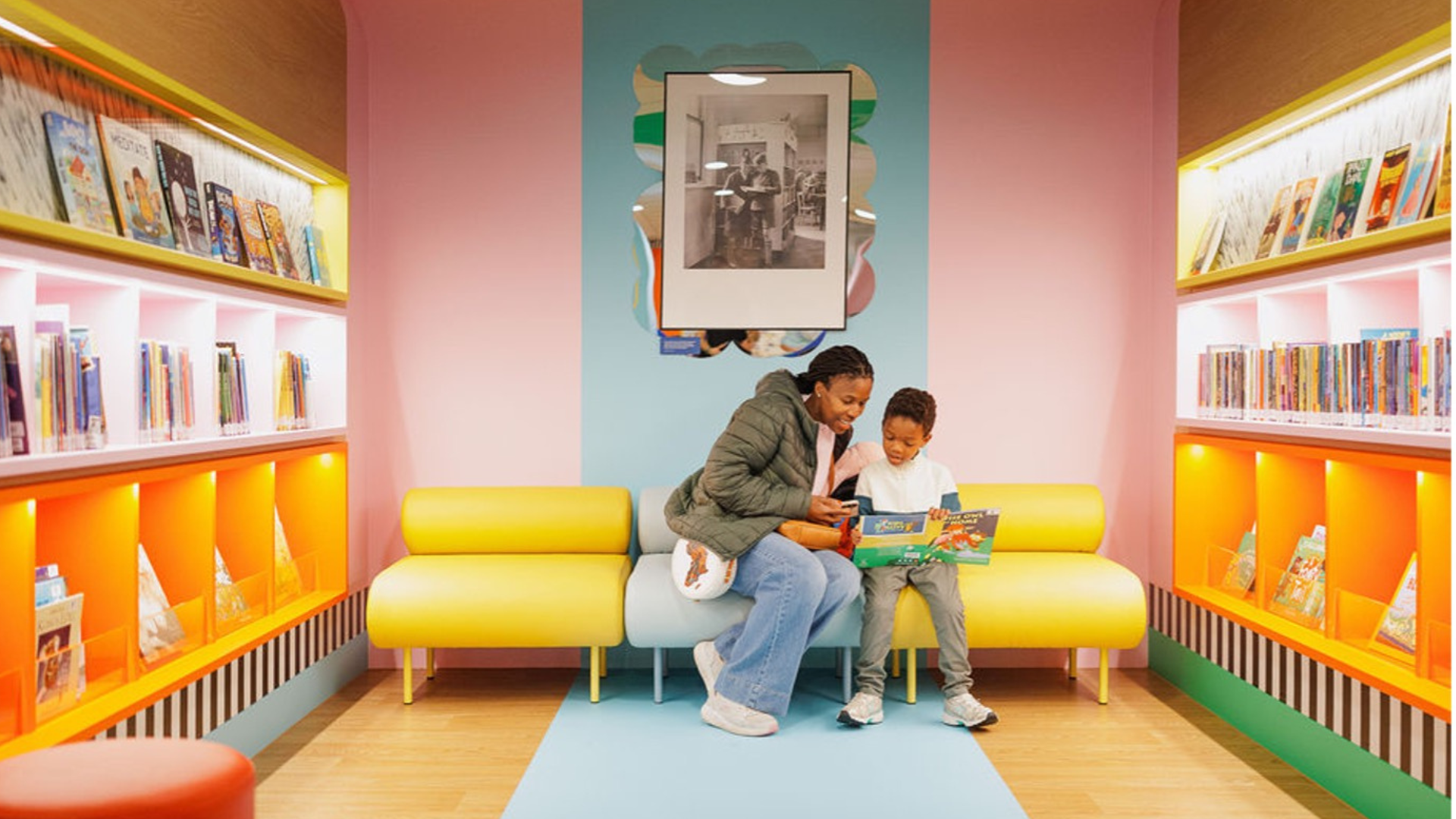
A giant Bunyip wanders through Adelaide carrying the Malls Balls. Familiar storybook characters peek out from unexpected corners. Children excitedly point out hidden details - they have found the green sheep - while their carers search alongside them. Nearby, colourful creatures spring to life on a digital wall, while families settle into reading nooks with stacks of books or a musical toy borrowed just moments before.
Welcome to Little Library, the new children's library and experience space at the State Library of South Australia.
Opened in August 2026, Little Library welcomed more than 1,800 visitors during its opening weekend alone, introducing many new families to the State Library and highlighting a strong appetite for spaces designed specifically for children and their carers. Grounded in the principles of Raising Literacy Australia’s Words Grow Minds framework, Little Library brings together reading, talking, singing and playing in a single experience designed to help children develop a lifelong love of stories, literacy and learning.
Rather than asking how children might fit into an existing library environment, the Little Library project team started with a different question: what would a library look like if it were designed from a child's point of view?
Bringing Read, Talk, Sing and Play to Life
From the beginning, the State Library wanted the principles of Words Grow Minds to be more than a communications message. The challenge was to translate them into a physical space.
The result is a library organised around four interconnected experiences or zones: Talk, Play, Sing and Read.
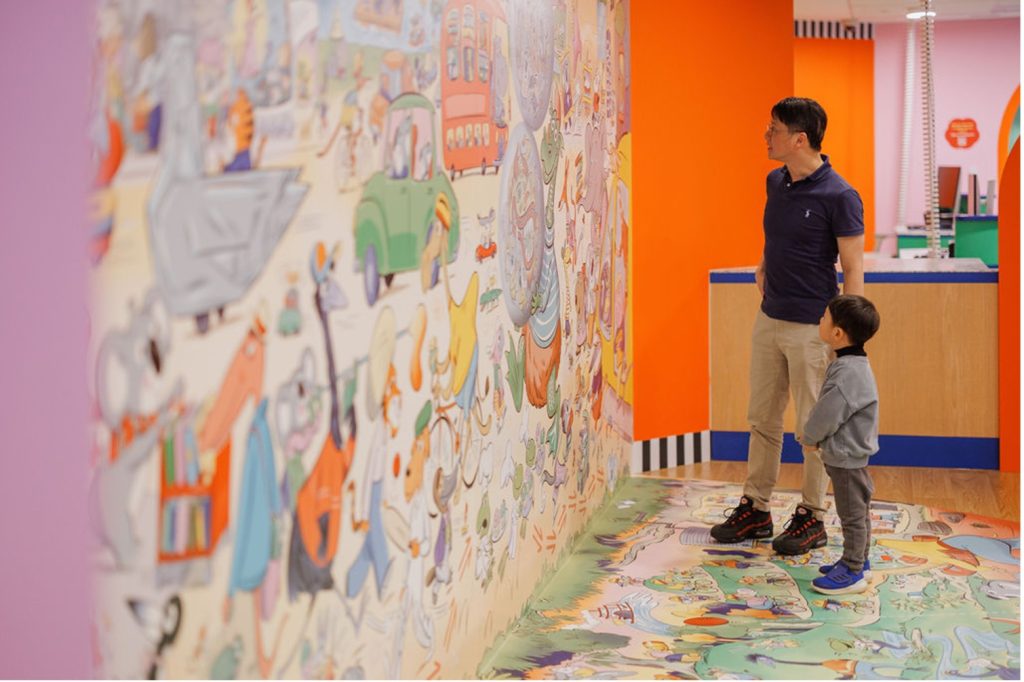
The Talk zone is anchored by a large, illustrated mural created by South Australian artists Andrew Joyner and Lawson Dodd. Like stepping into a storybook, the artwork is filled with curious characters, hidden details, local landmarks and playful references drawn from children's literature, the library’s collections and its home on Adelaide's North Terrace. Visitors might discover a familiar creature tucked into a corner, spot an object from the library's collection, or recognise a landmark from the cultural boulevard outside. The mural rewards careful observation and encourages children and carers to build stories together through conversation, questions and shared discoveries.
The Play zone takes a different approach. Children create faces, characters and creatures using physical tiles before scanning them into the experience. Moments later, to the visitors’ surprise and delight, their creations appear animated on a large projected wall, joining a constantly evolving world populated by characters made by other visitors. The experience combines physical and digital play while encouraging creativity, pattern making and collaboration.
The Sing zone incorporates elements of the Kaurna Songbook and was developed in collaboration with Adelaide University’s Kaurna Warra Pintyanthi and the Centre for Aboriginal Studies in Music. Kaurna people are the Traditional Owners of the Adelaide Plains, including the land on which the State Library stands. Designed as a self-guided experience, it introduces children and families to Kaurna language through rhythm, repetition, actions and song. Drawing on approaches used in language development and music therapy, the experience shows how libraries can support language learning, cultural connection, and encourage family participation at the same time.
The Read zone provides the strongest link to the wider State Library experience. During the design process, the team often referred to this area as the ‘Mini Mortlock’, as the shelving bay design is a nod to the iconic Mortlock Chamber upstairs. While visitors won't find the name on a sign, its influence is woven throughout the design. Reading nooks, intimate spaces for shared reading and curated borrowable collections invite children and carers to spend time together with stories. Display cases featuring material from the Library’s Children's Literature Research Collection sit alongside historical images of children's library spaces, creating quiet connections between today's young readers and generations who came before them.
This connection is central to the project's identity.
The Little Library name was chosen because the ‘big library’ is upstairs. Rather than creating a separate world for children, and despite its separate location, the space offers a child-sized introduction to the State Library itself, helping young visitors build a sense of familiarity and belonging within one of South Australia's most significant cultural institutions.
Creating a destination for families
Located among Adelaide's major cultural institutions on North Terrace, Little Library was designed to be more than a stop on a family outing.
The ambition was to create a destination in its own right. A place where families could spend time together, borrow books, participate in programs, engage with collections and discover stories before continuing their journey through the cultural boulevard.
To realise that vision, the State Library partnered with leading experience design agency Art Processors, which led the visitor experience design from concept through to delivery. Their role extended beyond design aesthetics, helping translate the project's literacy and engagement goals into a cohesive experience where every element supports the broader brief.
Several weeks after opening, staff are already seeing encouraging signs.
Children regularly lead adults through the space rather than the other way around. Families stay longer than anticipated. Visitors move naturally between reading, singing, storytelling, borrowing and play, often returning to favourite experiences multiple times during a single visit.
Perhaps the strongest measure of success is that Little Library feels genuinely owned by its audience. It is not uncommon to see children confidently introducing parents, grandparents and carers to the discoveries they have made.
Bringing together the best of two Libraries
Little Library is also notable for the partnership behind it.
Through a co-location model with City of Adelaide Libraries, families can borrow books, attend programs and participate in cultural experiences within a single space. The collaboration brings together City of Adelaide Libraries' strengths in lending services, family programming and community engagement with the State Library's collections, exhibitions and cultural programming.
For visitors, the experience feels seamless.
For the sector, the partnership demonstrates what can happen when organisations focus on shared outcomes and complementary strengths. The result is not a State Library service or a public library service, but something that combines the best of both.
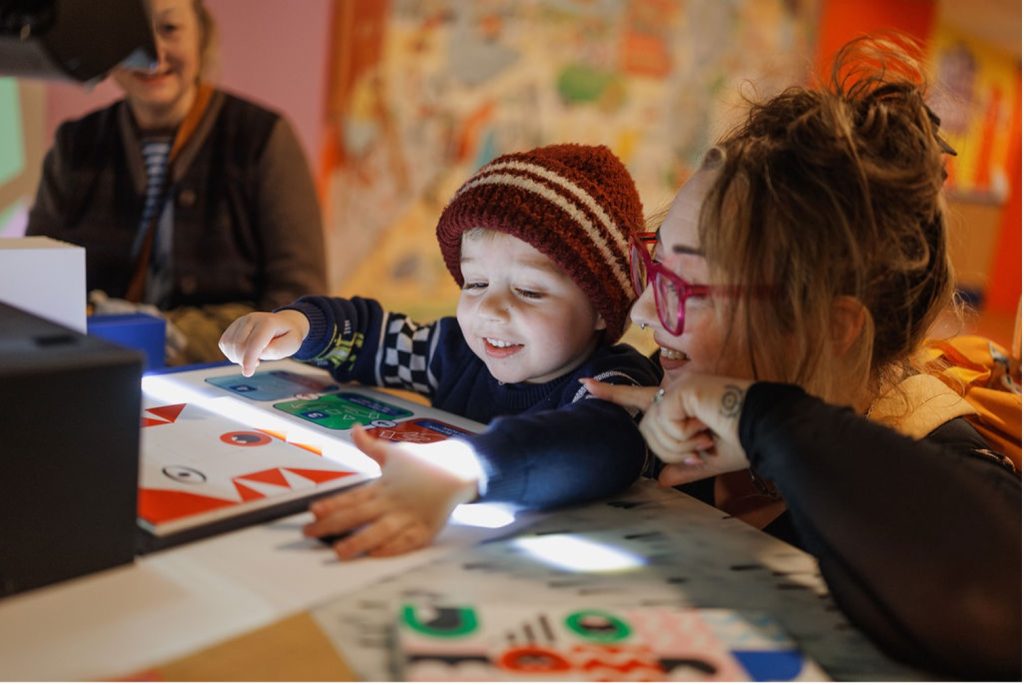
Little Library, State Library of South Australia (Photo by James Field)
Reflections on the journey
Little Library is still in its early months, but several lessons have already emerged.
The first is the value of having a clear foundation. The principles of read, talk, sing and play provided more than a framework for communication. They became a practical tool for decision-making, influencing everything from spatial planning and interactive design to programming and collection display.
The second is that designing for children requires more than shrinking adult spaces. It involves understanding how children discover, explore, communicate and learn, then creating environments that support those behaviours.
The third is the ongoing relevance of collections. Little Library demonstrates that heritage collections, cultural stories and contemporary library services can work together in ways that feel engaging and accessible for young audiences. References to the Mortlock Library, displays from the Children's Literature Research Collection and imagery drawn from the State Library's heritage collections help connect children with stories that span generations. Just as many adults fondly remember childhood visits to libraries, Little Library aims to create the moments and memories that today's children may look back on decades from now.
At a time when libraries across Australia continue to explore new ways of engaging children and families, Little Library offers one example of how literacy research, local storytelling, First Nations knowledge, cultural collections and collaboration can come together in a single place. Little Library was never intended to be separate from the State Library but designed as an invitation into it. A child-sized introduction to the ideas, collections and stories that make us.
State Library of South Australia
Little Library Project Team

0 Comments